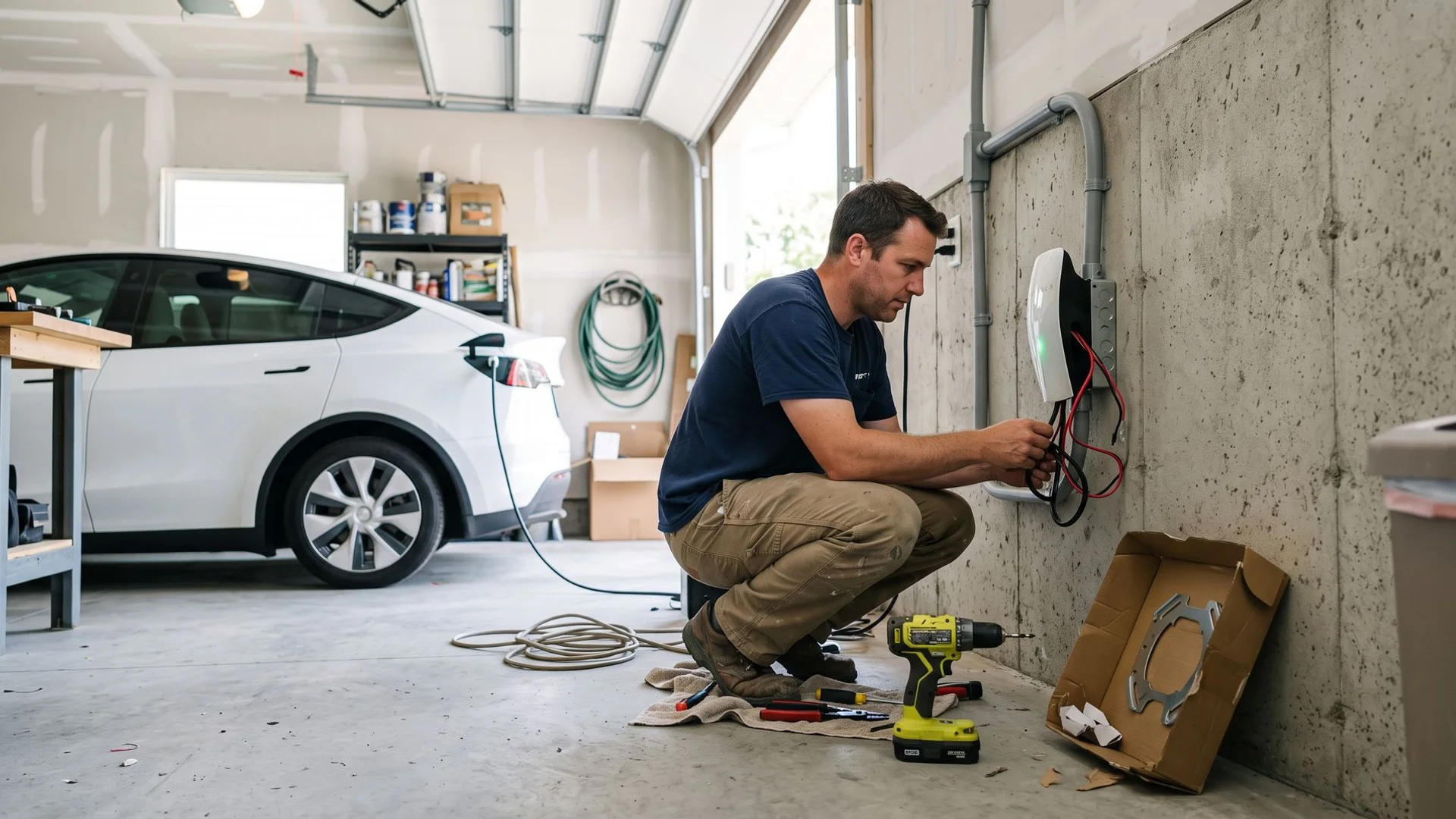
Electrician hardwiring a Tesla Gen 3 Wall Connector beside a Tesla Model Y in a Toronto garage

Highest Demand

Tesla Wall Connector Installation in Toronto & Across the GTA: Gen 3 Wall Connector, 60A Dedicated Circuit, NACS Adapter Support & Multi-Tesla Load Sharing

Best EV Charger Installation Toronto installs the Tesla Gen 3 Wall Connector across Toronto and the GTA for $1,800 to $2,800 CAD standalone, or $4,300 to $7,300 CAD when a 100A to 200A electrical panel upgrade is required. Every install is on a 60A dedicated circuit breaker delivering 48A continuous output, with power sharing across up to 6 Wall Connectors for households with 2+ Teslas. NACS-to-J1772 adapter compatibility means non-Tesla EVs charge from the same unit. NEMA 3R outdoor enclosure and Wi-Fi commissioning to the Tesla One app included.

Our Master Electrician commissions Tesla Wall Connector Gen 3 units with dedicated 60A breakers, 6 AWG copper feeders per OESC Section 8, hardwired terminations (not plug-in), WiFi network commissioning through the Tesla app, and load sharing configuration across up to 6 Wall Connectors on a shared feeder. Every install includes ESA permit filing, Certificate of Acceptance, and Tesla parts warranty registration on your behalf. We also install ChargePoint Home Flex, Grizzl-E, JuiceBox, and Wallbox units for non-Tesla EVs.

According to Tesla and IHS Markit registration data, Tesla vehicles make up roughly 40% of Ontario new electric vehicle registrations, and the Tesla Wall Connector Gen 3 with WiFi load sharing across up to 6 units is the most-installed home Level 2 charger across the Greater Toronto Area.

We install Tesla Wall Connector Gen 3 chargers with load sharing across up to 6 units throughout Toronto and the Greater Toronto Area, including Toronto, North York, Etobicoke, Scarborough, East York, Mississauga, Brampton, Vaughan, Markham, Richmond Hill, Oakville, Burlington, Milton, Ajax, Pickering, Whitby, Oshawa, Newmarket, Aurora, and all surrounding communities across Peel, Halton, York, and Durham Regions. Every install includes ESA permit filing, OESC Section 8 load calculation, Certificate of Acceptance, and utility service coordination with Toronto Hydro, Alectra Utilities, Elexicon Energy, Oakville Hydro, Burlington Hydro, Milton Hydro, or Newmarket-Tay Power depending on your service address.

Same-day quote, next-day install. We call you back within 2 hours.

$1,800 to $2,800 CAD

Same-day quote, next-day install

  • ✓ ESA/ECRA Licensed Electrical Contractor
  • ✓ Master Electrician (309A) on Staff
  • ✓ $2M General Liability, WSIB Insured
  • ✓ OESC Section 8 Load Calc on Every Quote
  • ✓ Built for Ontario Winter EV Charging
  • ✓ Toronto Hydro / Alectra / Elexicon Coordination
  • ✓ Ontario HRS Rebate up to $5,000 Filed for You
  • ✓ Same-Day Written Quote, Next-Day Install

Licensing

ESA/ECRA Licensed

Response

Same-day quote, next-day install

Insurance

$2M Liability · WSIB

Rebate

Ontario HRS filed for you

What is the Tesla Gen 3 Wall Connector?

The Tesla Gen 3 Wall Connector is a hardwired Level 2 charger that delivers up to 48A continuous on a 60A circuit. On a Model 3 or Model Y that is roughly 44 kilometres of range per hour, which turns an overnight park into a full battery without you thinking about it.

Our crew hardwires the unit with neutral-free wiring, commissions it over Wi-Fi through the Tesla app, and sets up power sharing for households running two or more Teslas. Indoor or outdoor NEMA 3R mounting, the ESA permit, and the inspection are all included in the price.

It is worth knowing the connector is no longer Tesla-only. The plug is the North American Charging Standard, now standardized as SAE J3400, and with a NACS to J1772 adapter the same Wall Connector charges a Ford, Hyundai, Kia, or Chevrolet EV. If your second car is not a Tesla, this unit still works for both.

Will your panel carry 48A continuous?

A 48A continuous load needs a 60A breaker and real spare capacity behind it. Under the 80 percent continuous load rule, that circuit is committed whether the car is plugged in or not, which is why the load calculation matters more than how much empty space the panel looks like it has.

If your service is a modern 200A with room to spare, this is a clean two to four hour job. If you are on a 100A panel, there are three routes: a smart EVEMS load management device such as a DCC-9 that sheds the charger when the house peaks, a dedicated subpanel if you have capacity but no breaker spaces, or a full 200A electrical panel upgrade. We price whichever one your OESC Section 8 calculation actually supports, and we quote the cheapest compliant option first.

Commissioning is where a lot of installs quietly underperform. The Wall Connector’s maximum amperage is set in the app during setup, and a unit left at a conservative default will charge slower forever without anyone noticing. We set it to what your circuit allows and show you the setting before we leave.

Common problems we solve

  • Charging slower than expected. Almost always a commissioning setting, not a fault.
  • Two Teslas, one circuit. Power sharing handles it without a second 60A run.
  • Panel with no 60A space. Subpanel or EVEMS instead of an automatic upgrade quote.
  • Long garage runs. Conduit routing and voltage drop calculated before the quote, not discovered on install day.
  • Outdoor mounting in winter. NEMA 3R placement, sealed penetrations, and a cable hook set above the snow line.

How does the install day work?

We arrive with the permit filed and the route already planned. The 60A breaker goes into the panel, conduit runs to the mounting point, and the unit is landed with neutral-free wiring and torqued to spec. Mounting height matters more than people expect, so we set it where the cable reaches your charge port without dragging on the floor.

Then it goes onto your Wi-Fi and into the Tesla app, where we configure the maximum amperage, confirm the firmware, and run a live charge session to verify the draw. If you are running two units, power sharing is configured and tested with both cars.

The ESA inspection follows, and once it passes we hand over the Certificate of Acceptance. We also register the manufacturer parts warranty on your behalf, and handle the Home Renovation Savings rebate filing if the unit and install qualify.

What does it cost across the GTA?

A standalone hardwired Gen 3 Wall Connector install runs $1,800 to $2,800 CAD. Short runs from a nearby panel sit at the low end. Long conduit runs over 12 metres, outdoor NEMA 3R mounting, or a detached garage feeder push toward the top of the range.

Add $2,500 to $4,500 CAD if your panel genuinely needs upgrading, or $500 to $1,200 CAD for a load management device where that is enough. Two-unit power sharing installs typically land at $2,800 to $3,800 CAD.

Every one of those numbers arrives as a fixed written quote with the ESA permit fee itemized, after the site inspection and before any work starts. The 2026 Home Renovation Savings program pays up to $5,000 CAD toward an eligible install, and we file that claim for you.

Tesla Wall Connector Gen 3 specs and install requirements

The Gen 3 Wall Connector runs on a 60A circuit and delivers 48A continuous output, which is 11.5 kW at 240V. The unit itself is compact (13.6 by 6.1 by 4.6 inches), weighs about 5.5 kilograms, and ships with a 24-foot cable that is heavy enough to reach the charge port from most mounting positions without a swing-arm accessory.

Circuit requirements are clean: a dedicated 60A double-pole breaker, 6-gauge copper conductors (or aluminium equivalent, sized up), and no shared neutral because the unit is neutral-free. Grounding is standard equipment ground back to the panel bar. Outdoor mounting uses the same unit under a NEMA 3R rating with sealed penetrations at the wall entry.

The internal ammeter is set during commissioning through the Tesla app over Wi-Fi. The maximum setting depends on the actual breaker and conductor size, so a 40A install (32A continuous) and a 60A install (48A continuous) look identical from outside the wall but charge at very different rates. We always set the amperage to what the physical circuit allows, then note the setting on the Certificate of Acceptance package we hand you at close-out.

Charging non-Tesla EVs with a Tesla Wall Connector (NACS to J1772)

Tesla’s connector uses the North American Charging Standard, now formalized as SAE J3400. In 2026 that connector is on Tesla, Ford, GM, Rivian, and most Korean marques for new models, but a lot of the installed base still runs J1772 on the vehicle side.

The bridge is a NACS to J1772 adapter, which is a passive plug that lets the Tesla-shaped connector deliver power to a J1772 inlet. Every Wall Connector on our installs supports this out of the box, and the adapter runs $175 to $225 CAD retail. Charging speed is capped by the vehicle’s onboard charger, which on most non-Tesla EVs is 7.7 kW or 11.5 kW, so the Wall Connector’s 48A continuous rating is usually not the limit.

If your household runs a mixed fleet (one Tesla, one non-Tesla), the Universal Wall Connector is worth the extra $50 to $100 because it ships with a built-in J1772 pigtail alongside the NACS handle, so you never have to hunt for the adapter.

Tesla load sharing for households with two or more Teslas

Power sharing on the Wall Connector lets up to six units share a single 60A circuit, dividing the available current between whichever vehicles are actually plugged in. That is a very different scheme from running two dedicated circuits, and it saves the panel space and often the panel upgrade cost that a second 60A circuit would need.

Setup is done through the Tesla app after both units are hardwired and commissioned. One unit is designated as primary and the others as followers on the same Wi-Fi mesh. When two Teslas plug in simultaneously, each gets 24A. When only one is plugged in, it gets the full 48A. When three or four cars are plugged in, the primary sequences them and reallocates as cars finish.

Practically, on a two-Tesla household with overnight charging windows of 8 to 10 hours, that shared circuit delivers a full charge to both cars comfortably by morning. We commission the pairing before we leave and verify a live share session with both vehicles.

Where should a Tesla Wall Connector be mounted?

Mounting height and cable position matter more than any other single install decision, because the unit lives at the height you set for the next 15 years. The Tesla spec places the unit at 1,220mm (48 inches) from the floor to the bottom of the enclosure, which puts the cable exit at roughly hip height.

The cable itself needs a hook or a holster within reach, sized so the connector head rests above the parking-surface splash zone. In a Toronto garage that means at least 200mm above the floor to clear road salt and slush drag through winter. On a driveway install with an outdoor NEMA 3R mount, the same principle applies but we also plan the cable drop so it does not sit in standing snow.

Parking side matters too. The Model 3 and Model Y charge port is on the rear driver-side quarter panel, so mounting on the driver-side wall of the garage puts the cable closest to the port. Model S and X are similar. Long cable throws over the vehicle body are workable but strain the cable over years.

Tesla Wall Connector vs Tesla Universal Wall Connector

Both units ship with the same 48A continuous rating, the same neutral-free wiring, and the same power sharing capability. The difference is on the customer side: the Universal ships with a built-in J1772 adapter integrated into the handle, so you can charge any J1772 EV without carrying a separate adapter piece.

For a Tesla-only household the Gen 3 is the right buy: it is $70 to $100 cheaper and the missing adapter is not needed. For a mixed household or a rental property, the Universal is worth the premium because guests and future owners can plug in without hunting for an adapter piece.

Retail pricing at Tesla directly is roughly $650 CAD for the Gen 3 and $735 CAD for the Universal. We install either at the same labour rate. If we supply the unit we register the manufacturer warranty on your behalf; if you buy it directly from Tesla the registration happens at your Tesla account level.

Tesla Wall Connector vs NEMA 14-50 outlet for GTA garages

The Wall Connector delivers 48A continuous against the 32A that a mobile charger on a NEMA 14-50 outlet can manage under OESC continuous-load rules. That is a 50 percent throughput advantage on a Tesla with an 11.5 kW onboard charger, which turns a 9-hour full-empty-full charge into a 6-hour one.

Hardwired installs also reduce GFCI nuisance tripping. A NEMA 14-50 outlet in Ontario now requires GFCI protection under OESC 26-724, and mobile chargers plugged into GFCI-protected outlets sometimes trip because the charger and the receptacle both attempt ground-fault detection independently. Hardwiring eliminates the second GFCI path.

The 14-50 wins in two scenarios: you rent or plan to move within 5 years, or you want to take the charger with you between two properties. For everyone else, the hardwired Wall Connector is the better long-term buy. See our hardwired 240V outlet installation page if the outlet path is where you land.
Transparent Pricing

How much does tesla wall connector cost in Toronto?

$1,800 to $2,800 CAD (CAD, standalone install). You get a fixed written quote with the ESA permit fee itemized before any work begins.

Standard Install

$1,800 to $2,200

  • Hardwired Gen 3 Wall Connector
  • Dedicated 60A circuit, 48A continuous
  • Wi-Fi commissioning via the Tesla app
  • ESA permit and inspection
Get Your Free Quote
Most Common

Long Run or Outdoor

$2,200 to $2,800

  • Everything in the standard install
  • Conduit run over 12 metres
  • NEMA 3R outdoor rated mounting
  • Weather sealing and support brackets
Get Your Free Quote

Two-Unit Power Sharing

$2,800 to $3,800

  • Two Wall Connectors on one circuit
  • Power sharing configured and tested
  • Load calculation for both units
  • Rebate paperwork filed for you
Get Your Free Quote

Range covers a hardwired Gen 3 Wall Connector on a dedicated 60A circuit, the ESA permit, and inspection. It excludes the unit itself unless we supply it. If your panel needs an upgrade, add $2,500 to $4,500 CAD, or $500 to $1,200 CAD for a load management device.

Why Us

Why choose us for tesla wall connector?

Neutral-free wiring done right

The Gen 3 unit does not need a neutral. We wire it correctly rather than pulling a conductor you will never use.

48A commissioning, not 32A

The amperage is set in the app during commissioning. We set it to what your circuit and load calculation actually allow.

Power sharing for two-Tesla homes

Two units on one circuit, sharing the available current. Usually cheaper than a second circuit or a panel upgrade.

Non-Tesla EVs supported

With a NACS to J1772 adapter the Wall Connector charges other EVs too, which matters when the second car is not a Tesla.

Outdoor mounting done properly

NEMA 3R rated placement, sealed penetrations, and cable management that survives a Toronto winter.

ESA permit included

Permit filed, inspection booked, Certificate of Acceptance handed over. Required for your rebate claim too.

Process

How does tesla wall connector work?

Four clear steps, with the ESA permit and inspection built into every one of them.

01

Tell Us Your Setup

Model, panel size, and where you park. We give you a price band on the call and book the site inspection.

02

Load Check and Route Plan

We confirm your service can carry 48A continuous, then plan the conduit route from panel to mounting point.

03

Hardwired Install

60A breaker, neutral-free wiring, unit mounted at working height, cable hook set where you actually reach for it.

04

Commission and Hand Over

Wi-Fi setup in the Tesla app, amperage configured, ESA inspection booked, Certificate of Acceptance to you.

Buyer beware

Common tesla wall connector mistakes to avoid

These are the four failure modes we see when a tesla wall connector is done poorly. Every one costs the homeowner more downstream, and every one is avoidable with proper preparation, code compliance, and a licensed crew.

1

Installing a Tesla Wall Connector as plug-in instead of hardwired

The Tesla Wall Connector Gen 3 is engineered for hardwired installation on a dedicated 60A circuit for 48A continuous output at 11.5 kW. Installing it as a plug-in on a NEMA 14-50 receptacle caps output at 32A continuous (7.6 kW), voids Tesla warranty coverage, and introduces a receptacle heat-cycling failure mode that manifests as a burning plastic smell in year two. Every proper Tesla Wall Connector install is hardwired to the branch circuit terminals.

2

Skipping WiFi commissioning and load sharing configuration

Multi-Tesla households require load sharing configured through the Tesla mobile app, which pairs up to 6 Wall Connectors on a shared circuit and dynamically allocates amperage between them. Skipping WiFi commissioning leaves each unit at maximum draw, which can trip the shared breaker or, worse, exceed the branch circuit ampacity when both vehicles charge simultaneously. Proper commissioning takes 15 minutes at the end of install.

3

Undersized breaker for the hardwired unit

A Tesla Wall Connector Gen 3 configured for 48A continuous requires a 60A double-pole breaker (80 percent of breaker rating per CSA continuous-load rules). Installing on a 50A or 40A breaker causes nuisance trips whenever the vehicle draws near maximum, especially in cold weather when battery preconditioning demands full amperage. Every proper install matches the breaker to the commissioned amperage in the Wall Connector settings menu.

4

Wrong conductor gauge

OESC Section 8 continuous-load rules require 6 AWG copper conductors on a 48A continuous circuit at 75-degree Celsius terminations. Some crews install 8 AWG (rated only for 40A continuous) to save wire cost, which passes visual inspection but exceeds the 60-degree ampacity rating and creates chronic overheating at the terminations. The right conductor is 6 AWG copper THHN or XHHW every time.

Comparison

How Best EV Charger Installation Toronto compares

Feature Typical provider Best EV Charger Installation Toronto
Charging speed configured Left at default settings 48A continuous where the circuit allows
App commissioning Left to the homeowner Configured and tested before we leave
Multi-unit power sharing Second circuit quoted Power sharing configured on one circuit
ESA permit Charged as an extra Included and itemized
Outdoor rating Indoor mount only NEMA 3R outdoor installs available

Our Work

Recent tesla wall connector jobs

Click any photo to enlarge.

Need tesla wall connector in the GTA?

Send us your address and vehicle. We call back within 2 hours with a price range and a next available install date.

Reviews

What customers say about our tesla wall connector

Recent installs from Toronto and GTA homeowners, in their own words.

"Same-day quote, next-day install. The crew ran a full load calculation, filed the ESA permit, and had my Tesla Wall Connector charging by the following afternoon. Fixed price, no surprises."

Ryan V.

North York

"Two Wall Connectors with power sharing in the garage. Clean routing, and both cars charge overnight with no issues."

Robert F.

Glen Abbey, Oakville

"Hardwired Tesla Wall Connector, tidy conduit run, and the ESA inspection passed the first time."

Wei L.

Unionville, Markham

FAQ

Tesla Wall Connector questions, answered

How much does Tesla Wall Connector installation cost in Toronto?

A standalone hardwired Gen 3 Wall Connector install runs $1,800 to $2,800 CAD, covering the 60A circuit, mounting, commissioning, ESA permit, and inspection. If your panel needs an upgrade, add $2,500 to $4,500 CAD, though a load management device at $500 to $1,200 CAD often avoids that.

How fast does the Gen 3 Wall Connector charge?

Up to 48A continuous on a 60A circuit, which is roughly 44 kilometres of range per hour on a Model 3 or Model Y. Your actual rate depends on your vehicle's onboard charger and the circuit your service can support. We configure the maximum your load calculation allows during commissioning.

Can a Tesla Wall Connector charge a non-Tesla EV?

Yes. Tesla's connector uses the North American Charging Standard (NACS, standardized as SAE J3400). With a NACS to J1772 adapter the Wall Connector charges a Ford, Hyundai, Kia, or other J1772 vehicle. The Tesla Universal Wall Connector includes a built-in J1772 adapter if you want that without carrying one around.

Can I install two Wall Connectors for two Teslas?

Yes, and power sharing is the usual answer. Up to six units can share a single circuit, dividing the available current between whichever cars are plugged in. That is normally far cheaper than running a second 60A circuit or upgrading the panel.

Does the Wall Connector need a neutral wire?

No. The Gen 3 Wall Connector runs on two hot conductors and a ground, with no neutral required. Wiring it neutral-free keeps the conduit run simpler and cheaper, and it is exactly how the unit is designed to be installed.

Can the Wall Connector be mounted outside in a Toronto winter?

Yes. The unit is rated for outdoor installation, and we mount it in a NEMA 3R rated configuration with sealed penetrations and proper cable management. It operates through Ontario winters without trouble, though we do plan the mounting height so the cable is not sitting in snow.

Do I need an ESA permit for a Tesla Wall Connector?

Yes. Every EV charger installation in Ontario requires an Electrical Safety Authority permit and inspection. We file it, schedule the inspection, and hand you the Certificate of Acceptance. That permit is also required for your Home Renovation Savings rebate claim.

Is a Wall Connector better than a NEMA 14-50 outlet?

For most Tesla owners, yes. The hardwired Wall Connector delivers 48A against the 32A a mobile connector on a NEMA 14-50 can manage, and hardwiring reduces GFCI nuisance tripping. The outlet wins only if you rent, plan to move, or want to take the charger with you.

Do you supply the Wall Connector or do I buy it?

Either works. Most customers order directly from Tesla and we install it. If you prefer, we can supply the unit and register the manufacturer parts warranty on your behalf. Warranty terms come from Tesla, typically 3 to 4 years for residential use.

Still have a question about your panel or your charger?

Ask Our Crew

Get a free tesla wall connector quote

We will call you within 2 hours. No obligation.

ESA/ECRA licensed. Master Electrician on staff. WSIB insured and bonded. We never share your details.

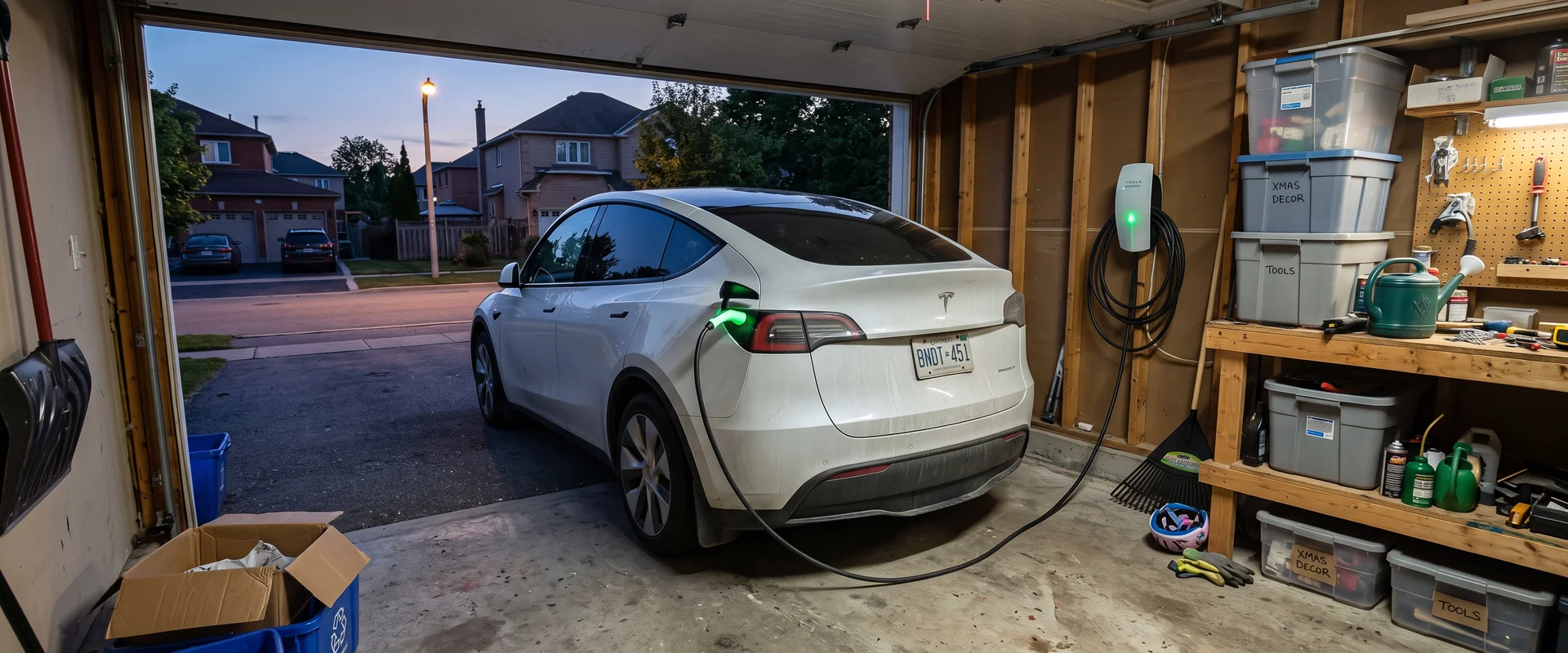
Electric vehicle charging from a wall-mounted Level 2 charger in a Toronto garage

2026 Ontario EV Rebate: up to $5,000 for eligible installations

Book your tesla wall connector today

Best EV Charger Installation Toronto installs the Tesla Gen 3 Wall Connector across Toronto and the GTA for $1,800 to $2,800 CAD standalone, or $4,300 to $7,300 CAD when a 100A to 200A electrical panel upgrade is required. Every install is on a 60A dedicated circuit breaker delivering 48A continuous output, with power sharing across up to 6 Wall Connectors for households with 2+ Teslas. NACS-to-J1772 adapter compatibility means non-Tesla EVs charge from the same unit. NEMA 3R outdoor enclosure and Wi-Fi commissioning to the Tesla One app included. Fixed written quote, ESA permit included, rebates filed on your behalf.

  • ESA permit and inspection included
  • Fixed written pricing, no hidden fees
  • Rebates filed on your behalf
Call Now Free Quote