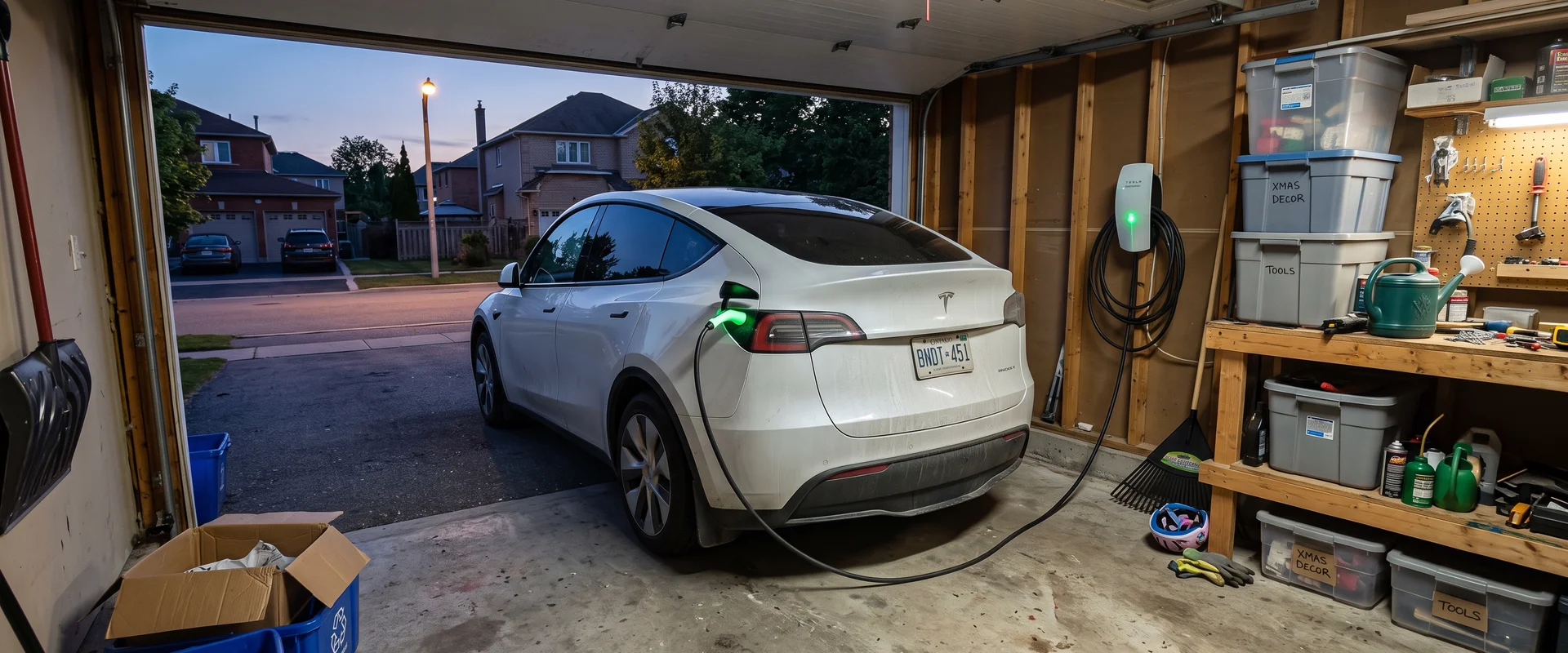
What goes wrong with Level 2 chargers?
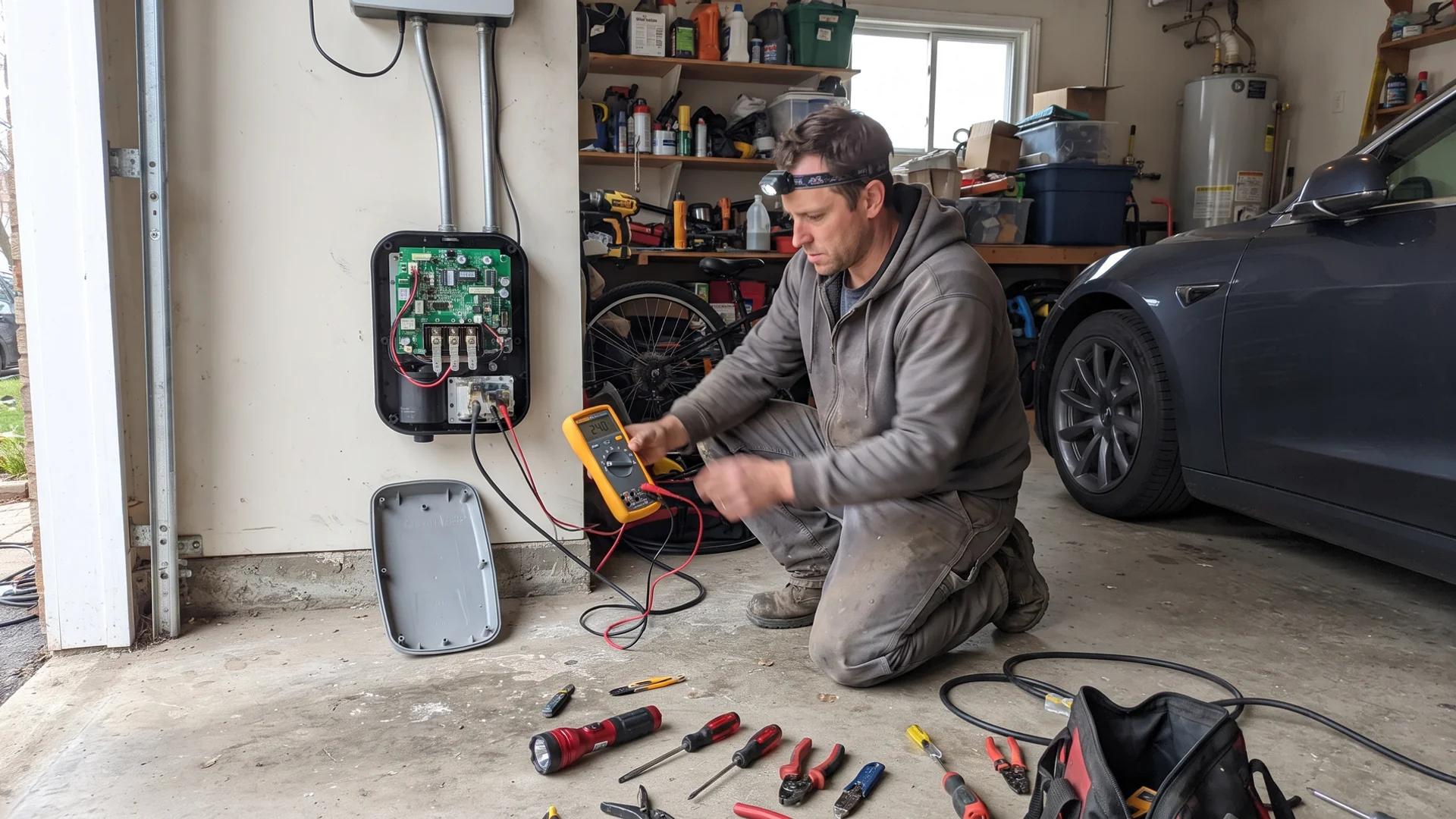
When a Level 2 charger stops working, our crew runs a full diagnostic and repairs the common faults: GFCI nuisance trips, communication faults, circuit board failures, and physical damage. We service the major brands and will tell you honestly when a repair beats a replacement or when it is time to upgrade to a faster unit. The diagnostic is $150 CAD, with a typical repair running $250 to $800 CAD.
The important thing to know before you buy a replacement: a large share of “broken charger” calls turn out not to be the charger. The circuit, the breaker pairing, the receptacle, or the connector is the culprit at least as often as the unit itself. Replacing a working charger is an expensive way to not fix the problem.
That is why the diagnostic comes first, and why it is credited against whatever repair you authorize.
What do the common faults look like?
Repeated breaker trips. Usually GFCI stacking, where the charger’s own ground fault detection and a GFCI breaker interfere with each other, or moisture in an outdoor receptacle. Sometimes a genuine ground fault in the circuit, which is the one you actually want found.
Charging will not start. Often a communication fault. Level 2 charging depends on a control pilot handshake between vehicle and charger, and a damaged cable, corroded pins, or a failing board breaks that conversation without cutting power.
Charging is slower than it used to be. Frequently a configuration change rather than a fault, especially on units with app-set amperage. Occasionally thermal derating from a connector that is heating up under load, which is a real warning sign.
Scorched or melted connector housing. Heat from a poor connection. Stop using it, switch the circuit off, and call us. This one is not a wait-and-see fault.
Common problems we solve
- GFCI nuisance tripping from incompatible breaker and charger pairings.
- Water ingress in outdoor receptacles and enclosures after a Toronto winter.
- Failed circuit boards on units past their manufacturer parts warranty.
- Damaged cables and connectors from being driven over or left in a doorway.
- Non-compliant original installs that were never permitted or inspected.
How does the diagnostic work?
We test in order, from the panel outward. Breaker and circuit first, including insulation and ground integrity. Then the charger’s supply, its internal protection, and its status codes. Then the connector, the pins, and the cable. Then the vehicle handshake with your car actually plugged in.
You get the fault in writing along with the fix, the price, and an honest read on repair versus replacement. Where the unit is still inside its manufacturer parts warranty, typically 3 to 5 years depending on brand, we file the claim rather than selling you a part you are entitled to receive.
After the repair we run a full charge session with the vehicle connected. A charger that powers up is not a charger that works, and we do not call it done until we have watched it deliver current cleanly.
When is replacement the better buy?
Three situations point that way. The board has failed on an out-of-warranty unit and the part costs 70 percent of a new charger. The unit is an early-generation 16A or 32A model and you would genuinely benefit from 48A. Or the enclosure has physical or water damage that makes a reliable repair unlikely.
In any of those cases we credit the $150 diagnostic toward the new install, whether that is a hardwired Tesla Wall Connector or another Level 2 unit, and we quote the replacement with the ESA permit and inspection included, exactly as we would a fresh install. If the new unit is ENERGY STAR certified, it may also qualify for the Home Renovation Savings program, which we file for you.
If the fault is sparking, smoking, or a burning smell, do not wait for a scheduled repair slot. Switch the circuit off at the panel and call our 24/7 emergency EV charger service, which targets a 2-hour on-site response for safety-critical calls across the GTA.