What does commercial EV charging involve?
From employee-facing Level 2 chargers to DC fast chargers for public networks, our crew designs and installs commercial EV charging with load management for multi-charger sites, 480V three-phase distribution, and OCPP-compatible networking. We coordinate utility service, file permits, and help you subsidize capital cost through the federal ZEVIP program and Ontario rebates.
The engineering problem is different from a house. A residential install asks whether one service can carry one charger. A commercial install asks how many chargers a site can carry simultaneously, what that does to your demand charges, who pays for the electricity, and how you add stalls five through twelve without redoing the feeders.
That is why we scope commercial work from the electrical room outward: available capacity first, then distribution, then the charger count and the management layer that keeps them inside the envelope.
How do you keep demand charges under control?
Commercial electricity bills are not just consumption. A meaningful share is the demand charge, set by your highest measured draw in the billing period. Install six 48A chargers with no coordination, let them all start at 5pm, and you have written yourself a new peak that follows you on the bill for months.
Load management solves it. The system caps total charger draw at a level your service and your demand tier can absorb, then divides that budget between active sessions. Cars charge slightly slower during busy periods, which nobody notices when the vehicle is parked for eight hours anyway.
For fleet depots the same logic runs overnight, sequencing vehicles so the depot never exceeds its target while every van is full by the morning shift. Where the site is genuinely capacity-limited, that design is often the difference between a project that works and a utility service upgrade you did not budget for.
Common problems we solve
- Demand charge shock after an uncoordinated multi-charger rollout.
- Sites sized only for today, where adding a fifth charger means retrenching the lot.
- Vendor lock-in on closed networking platforms with rising software fees.
- No cost recovery, where the property quietly funds tenant and employee charging.
- Stalled DCFC projects where the utility capacity study was left until the end.
What about DC fast charging?
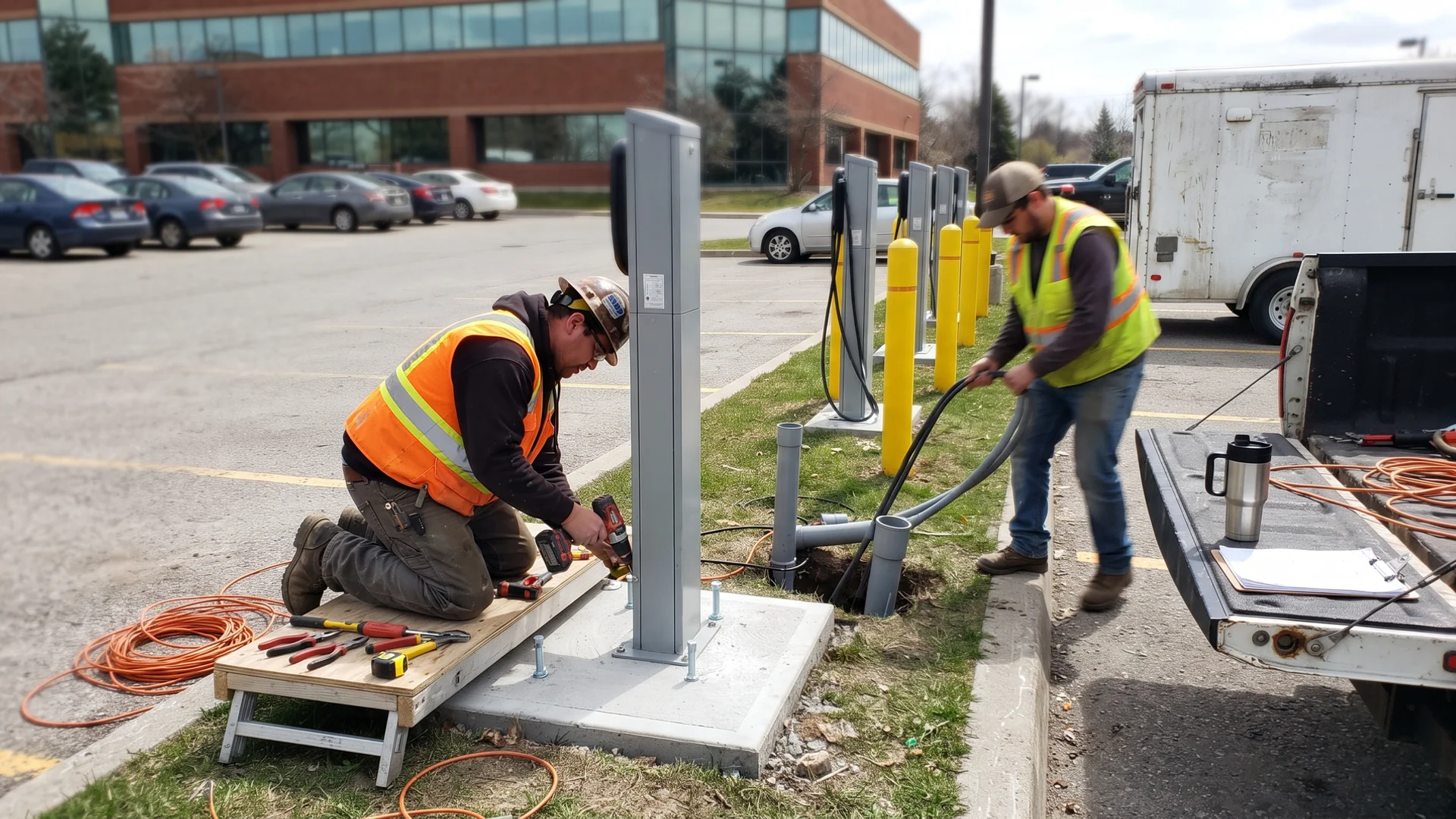
DC fast charging is a different scope entirely. A DCFC unit needs 480V three-phase supply, a poured concrete transformer pad, substantial trenching, and a utility capacity study that has to be started early rather than late. CCS1 is the dominant connector on Canadian public networks, with CHAdeMO still present on older vehicles and NACS increasingly supported through adapters.
Budget $30,000 to $100,000+ CAD per site depending on the unit, the utility capacity available, and how much civil work the lot needs. Timelines are typically 3 to 6 months. Federal ZEVIP funding has historically covered a meaningful share of eligible capital cost for public-facing installations, which changes the business case considerably.
If your goal is customer dwell time rather than fast turnaround, we will often recommend networked Level 2 instead. Two Level 2 chargers at a retail site frequently serve more customers per dollar than one DCFC.
How is a commercial project delivered?
We start with a scoping call to establish property type, parking count, existing service, and what you want the chargers to achieve. Residential condo boards follow a different path, covered under condo EV charger installation. Then a site assessment covers capacity, distribution, the conduit or trenching route, bollard protection, and signage.
Permits go in, utility capacity is confirmed, and we point you at the funding programs currently open. Installation covers the civil work, feeders, chargers, and the management layer. Commissioning brings the chargers onto an OCPP platform, sets access control and billing rates, and confirms the load management behaves under real simultaneous load.
You finish with permitted, inspected infrastructure, documentation for your records and your insurer, and a system that can scale when the next tenant or the next fleet vehicle arrives.