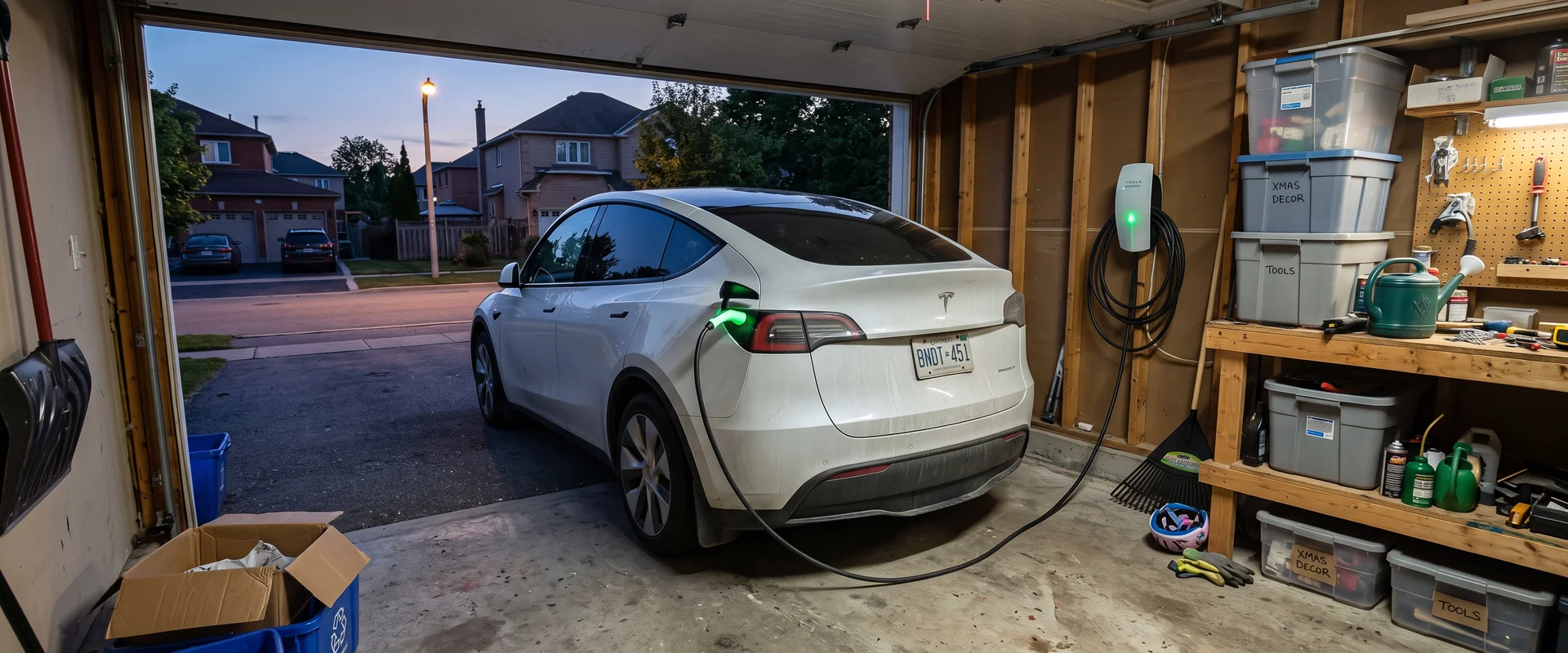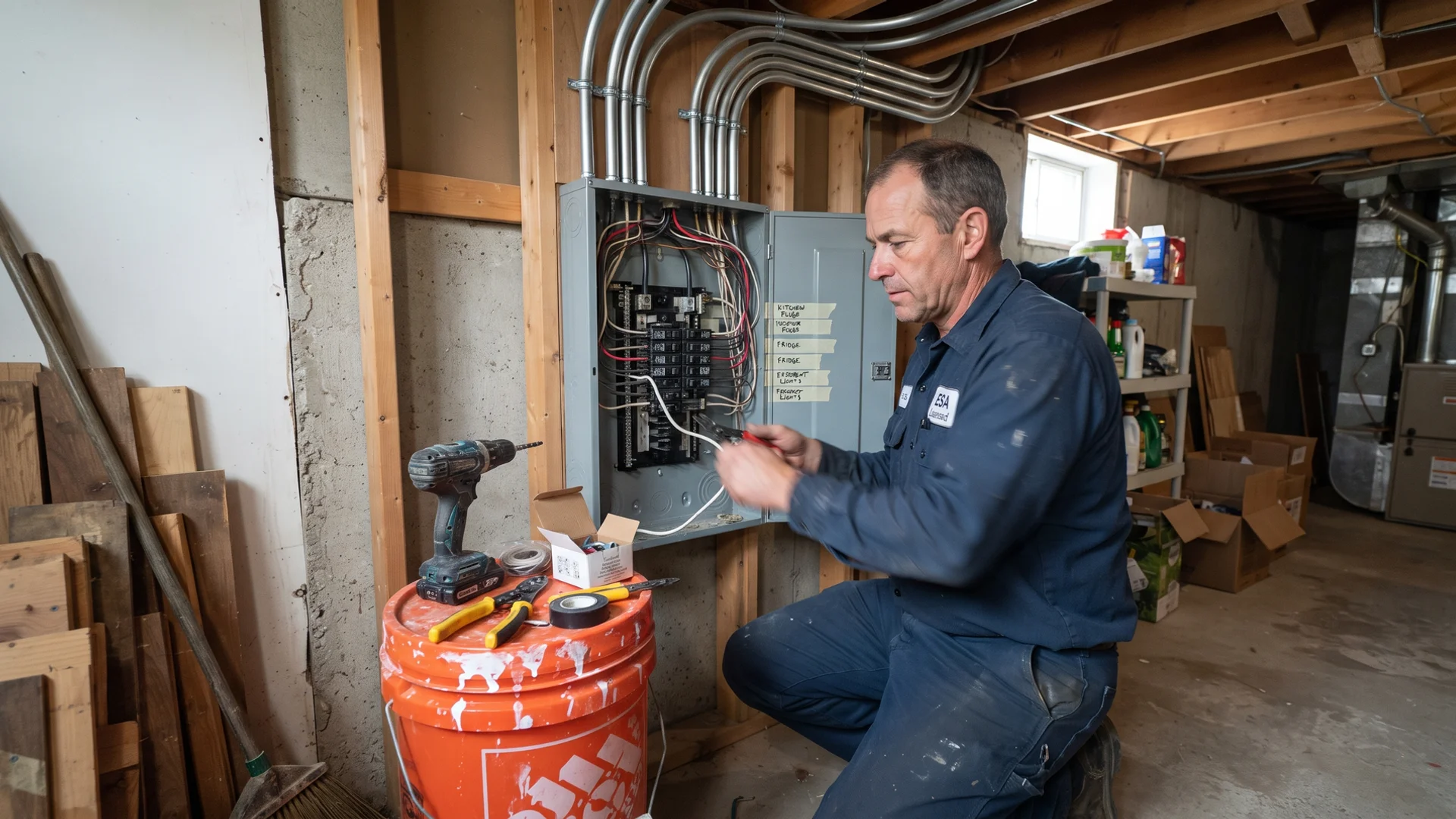
What is an electrical panel upgrade?
An electrical panel upgrade replaces the breaker panel and, where required, the service feeding it, so your home can carry loads it was never wired for. Most GTA houses built before the EV era run 100A service with a panel that is already full. Adding a Level 2 charger means adding a 48A continuous load, and that is exactly the point where a 100A service starts to run out of room.
Our crew upgrades your service from 100A to 200A, replaces the breaker panel, and runs a full load calculation to the Ontario Electrical Safety Code (OESC Section 8). We file the ESA permit, coordinate the Toronto Hydro service upgrade where the service itself is changing, and hand over the Certificate of Acceptance so your install is fully compliant and ready for the charger.
The upgrade is not only about the car. A 200A service with spare breaker spaces also covers a heat pump, a hot tub, a basement suite, or an induction range later. Doing it once, properly documented, is cheaper than doing it twice.
Do you need a panel upgrade, or something cheaper?
This is the question that decides your budget, so we settle it before quoting. There are three genuinely different situations, and they cost very different amounts.
If your service capacity is fine but the breaker spaces are gone, you do not need an upgrade. A dedicated subpanel gives the EV circuit a home for $1,500 to $2,800 CAD. If your capacity is genuinely tight, a smart EVEMS load management device such as a DCC-9 or DCC-12 sheds the charger load when the household peaks, satisfying OESC Rule 8-106 for $500 to $1,200 CAD. If your service is undersized for the way you actually live, with electric heat, a pool, or a second EV coming, the full 200A service upgrade is the honest answer.
The OESC Section 8 load calculation is what separates those three. We total your connected load, apply the code demand factors, and compare the result against your existing service. That number goes on your quote so you can see the reasoning rather than take our word for it.
Common problems we solve
- Full panel, no spare double pole space. Every breaker slot is used and there is nowhere to land a 60A EV circuit.
- Legacy fuse or split-bus panels. Common in The Annex, Riverdale, Leaside, and older Etobicoke homes. These cannot take an EV circuit and must be replaced.
- Undersized 60A or 100A service. Fine for a 1960s house, tight once you add a Level 2 charger and modern appliances.
- Aluminum branch wiring and aging bus bars. Found during inspection and dealt with properly rather than worked around.
- Failed or missing documentation. No ESA Certificate on record from previous work, which insurers and buyers will notice.
What happens on upgrade day?
We arrive with the new panel, breakers, and the permit already filed. The service is de-energized, the old panel comes out, and the new 200A panel goes in with fresh breakers and dressed wiring. Each circuit is traced, landed, and labelled on a printed directory taped inside the door.
Where the service itself changes, the work extends to the service mast, the meter base, the point of attachment, and a copper ground plate. That part is scheduled around the Toronto Hydro (or Alectra, or Elexicon) disconnect and reconnect, which is why those jobs run 1 to 2 weeks rather than a single day.
Power is back on the same day for a standard panel swap. The ESA inspection follows, and once it passes we hand you the Certificate of Acceptance. That document is what proves the work was done to code, and it is the first thing a home insurer or a buyer’s lawyer will ask about.
What does it cost in Toronto and the GTA?
A 100A to 200A panel upgrade runs $2,500 to $4,500 CAD. A full service upgrade including a new mast and meter base runs $3,500 to $5,500 CAD. Bundled with the Level 2 charger install itself, most GTA homes land between $4,000 and $7,300 CAD all in.
What moves you inside that range is the condition of what we find: the length and route of the service run, whether the meter base and mast need replacing, whether the grounding needs to be brought up to current code, and how much remedial work the existing circuits need. All of it is priced in writing before we start, with the ESA permit fee shown as its own line.
The 2026 Home Renovation Savings program pays up to $5,000 CAD toward an eligible EV charger installation with an ENERGY STAR certified charger and an ESA permit. We handle the Ontario EV rebate filing on your behalf, which for a lot of homeowners takes a meaningful bite out of the combined upgrade and install cost.
Signs you need an electrical panel upgrade for EV charging
The clearest sign is a panel that has no double-pole slots left, because a Level 2 EV circuit needs two adjacent breaker positions for a 40A or 60A double-pole. A quick look inside the panel tells us most of what we need on the first visit, though we always run the full OESC Section 8 load calculation before quoting either an upgrade or an alternative.
Other flags that push a home toward an upgrade rather than a workaround: a legacy fuse panel (any fuse panel needs to go before an EV circuit is legal), a split-bus panel with no true main disconnect, a Federal Pacific Stab-Lok or Zinsco panel (well-documented failure history and most insurers now require replacement), or aluminium branch wiring throughout the panel bar.
Load-related flags include: a house that already runs an electric range, electric dryer, central AC, and an electric water heater on a 100A service, or planned additions like a heat pump, induction range, or in-suite laundry. Any two of those on top of a Level 2 EV charger will typically push a 100A calculation over the code limit even with EVEMS load management installed.
Can I install a Level 2 charger on a 100A panel?
Very often yes, but the answer comes from the load calculation, not from panel appearance. Under OESC Section 8, we sum the connected loads at code-defined demand factors, add the EV load at its 80 percent continuous rating (32A for a 40A circuit, 48A for a 60A), and confirm the total sits at or below 100A with normal safety margin.
When the number is tight but under 100A, a DCC-9 or DCC-12 EVEMS device under OESC Rule 8-106 is the sensible route. The EVEMS uses current-transformer clamps on the main service conductors to measure real-time draw and sheds the EV load when household demand peaks. The code treats the EV load as non-coincident under that arrangement, which effectively removes it from the calculation.
When the number exceeds 100A even with an EVEMS installed, the honest answer is a panel upgrade or a full service upgrade. Trying to force an EV circuit onto an overloaded service is what causes the main breaker to trip during heavy use, and in the worst cases overheats service conductors that were never designed to carry the added load.
How an electrical load calculation determines your panel needs
The calculation follows OESC Section 8, which starts with the basic load allowance for the dwelling square footage (typically 5 kW for the first 90 square metres and 1 kW for each additional 90). To that we add specific appliance loads at their nameplate ratings, with defined demand factors that recognize not every load runs simultaneously.
The heavy loads dominate the total: electric range at 6 kW or nameplate whichever is greater, electric dryer at 1 kW or nameplate, central AC at nameplate, electric water heater at nameplate, and any electric heating. Where an EV is added, the charger goes on at its continuous rating (32A or 48A depending on the circuit).
We run this calculation on paper (or on our tablet) at the site inspection and show you the result. It is the number that decides whether a panel upgrade is genuinely required, whether an EVEMS satisfies the code, or whether a subpanel from spare bus capacity is the right route. Every quote leaves with the load calculation attached.
Toronto Hydro service upgrade coordination explained
Any change to the service side, meaning the mast, meter base, or point of attachment, requires a Toronto Hydro Service Layout Request and a coordinated disconnect and reconnect. The typical Toronto Hydro process runs 2 to 4 weeks from request submission to energized new service, though we routinely land in 1 to 2 weeks on well-scoped residential jobs.
The sequence: we file the ESA permit and the Toronto Hydro layout request together. Toronto Hydro reviews the load calc and issues a service upgrade approval. On install day we replace the mast and meter base, and Toronto Hydro attends to pull the drop, physically disconnect the incoming service, and reconnect once we have the new service tested. ESA inspects the same day or the next, and Toronto Hydro closes the file when the Certificate of Acceptance is issued.
Alectra Utilities (Mississauga, Vaughan, Brampton, Markham), Oakville Hydro, Burlington Hydro, Elexicon Energy (Ajax, Whitby, Pickering, Richmond Hill), Hydro One, and Newmarket-Tay Power all follow similar processes with their own portals and layout drawing requirements. We handle whichever utility serves your address.
Panel upgrade vs load management: which do you need?
Two different answers to the same problem, and the load calculation decides which fits. If your OESC Section 8 load sits comfortably under 100A even with the EV added at continuous rating, an EVEMS load management device is almost always the cheaper right answer. It runs $500 to $1,200 CAD installed, takes half a day, and does not require any utility involvement.
If the load calc exceeds 100A with the EV added, or if the panel has no physical space for a 60A double-pole, the EVEMS route stops working and a panel upgrade becomes the real answer. A 100A to 200A panel swap runs $2,500 to $4,500 CAD, takes a full day plus ESA inspection, and does not require utility coordination unless the mast or meter base needs replacement.
If the mast or meter base is undersized, or the service entrance conductors are 100A copper feeding into a proposed 200A panel, that is when a full service upgrade at $3,500 to $5,500 CAD is required. Utility coordination adds 1 to 2 weeks to the timeline.
How much does a panel upgrade cost in Ontario?
A basic 100A to 200A panel swap in Toronto and the GTA runs $2,500 to $3,200 CAD when the mast and meter base are current-generation and only the panel itself needs replacement. That covers the new panel enclosure, new breakers, wire dressing, the OESC Section 8 load calculation, the ESA permit fee, and the inspection.
A panel swap combined with new breakers for high-draw circuits (EV charger, heat pump condenser, induction range, in-suite laundry) sits higher at $3,500 to $4,500 CAD because of the added breaker cost and the extra hours to correctly land the new circuits. This is the most common scope on a house preparing for EV plus a future heat pump.
A full service upgrade with new mast, meter base, service entrance conductors, and 200A panel runs $3,500 to $5,500 CAD, plus 1 to 2 weeks of utility coordination. Homes in older neighbourhoods (The Annex, Leaside, Kingsway) sometimes need the service head relocated for building code clearances, which adds $500 to $1,200 CAD.
100A vs 200A service for EV charging
100A service is enough for a Level 2 EV charger in most detached homes today, especially with an EVEMS load management device that removes the EV from the code calculation. Where 100A stops working is when a heat pump, an induction range, or a second EV joins the load. Any two of those on top of the first EV pushes the calc past code even with an EVEMS in place.
200A service is enough for two EVs (either on separate circuits or power-shared on a single Wall Connector circuit), a cold-climate heat pump, an induction range, an electric dryer, an electric water heater, and standard household load, all simultaneously. That is the practical answer for a house that is being electrified fully.
If your home is on 100A today and you only need the EV charger, take the load calculation and consider EVEMS first. If you plan any second major electric addition within 5 years, the panel upgrade pays back quickly through avoided disruption on the second addition.