What makes a condo EV charger install different?
Installing an EV charger in a condo means working through the Ontario Condominium Act Section 98 approval process, board timelines, and shared-parking metering. The wiring is the straightforward part. The approval, the insurance, and the billing arrangement are where most owners get stuck for months.
Our crew handles the technical assessment, the load management design, and the submetering versus common-element billing decision, then coordinates with condo insurance and property management. We provide a Certificate of Insurance on request for boards and property managers, which is usually the first thing they ask for.
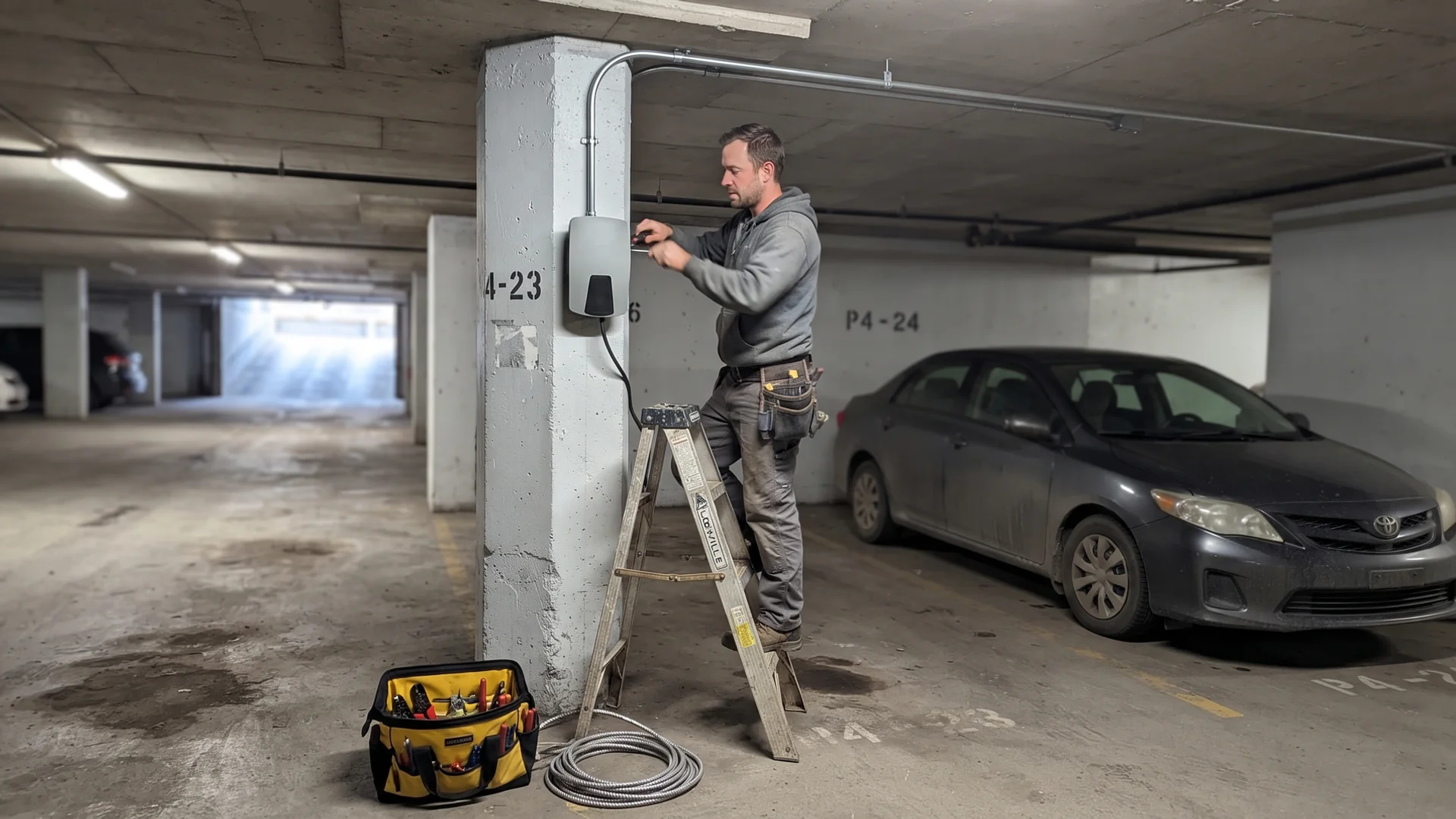
The physical work depends on your building. A stall near the electrical room may need only a short conduit run. A stall three levels down needs core drilling through concrete slabs, fire-stopped penetrations, and a routed feeder that will not interfere with sprinklers, ventilation, or clearance requirements.
How does the Section 98 approval work?
Section 98 of the Ontario Condominium Act covers changes an owner makes to common elements. Your parking stall is a common element or an exclusive-use common element in almost every building, so a charger falls squarely under it.
The section requires a written agreement between you and the corporation covering who installs it, who maintains it, who insures it, and what happens when you sell. The board cannot refuse a reasonable request without valid grounds, but “we do not have the information to assess this” counts as valid grounds. That is why incomplete applications sit for months.
What a board actually needs to say yes: a documented load study showing the building can carry the charger, a clear billing arrangement so no other owner subsidizes your electricity, proof of the contractor’s insurance and licensing, and a description of the physical work including how penetrations will be fire-stopped. We prepare all of that as the technical package behind your application.
Common problems we solve
- Applications stalled at the board. Usually missing a load study or a billing plan, both of which we supply.
- “The building has no capacity.” Often untrue, and where it is true, an EVEMS design solves it without a new building service.
- Billing disputes. Settled upfront with revenue-grade submetering through Wyse Meter Solutions, Carma, or SWTCH Energy.
- Insurance objections. Answered with a Certificate of Insurance showing $2M general liability, WSIB coverage, and bonding.
- One-off installs that block the next owner. We design the first stall so the building can add more without starting over.
How is the electricity metered and billed?
There are two workable models and one that causes arguments. Dedicated submetering puts a revenue-grade meter on your charger so you are billed for exactly what you draw. Common-element billing runs the load through the corporation’s account with a cost-recovery arrangement written into the Section 98 agreement. The third option, quietly drawing from a shared circuit with no metering, is what boards are trying to prevent, and rightly so.
Most Toronto boards now prefer submetering because it settles the fairness question permanently. Providers such as Wyse Meter Solutions, Carma Corp, and SWTCH Energy handle billing directly with the owner, and networked chargers on the FLO or ChargePoint platforms can integrate access control for shared stalls.
Where the building is capacity-constrained, an EVEMS load management layer sits above all of it, dividing available current between active chargers so the building service is never exceeded. That design is what turns a single approved stall into a building that can support twenty.
What does it cost, and how long does it take?
Per-unit installs run $2,500 to $6,500 CAD. Short runs with existing capacity sit at the low end. Long runs, core drilling between parking levels, and dedicated submetering push toward the top. Full-building MURB infrastructure is scoped and quoted per project alongside our commercial EV charger installation work.
The install itself takes one to two days. Board approval is the long pole: typically 4 to 12 weeks depending on how often your board meets and how complete the first submission is. Starting with a full technical package is the difference between one board meeting and four.
Every install includes the ESA permit, inspection, and Certificate of Acceptance, and we handle the Home Renovation Savings rebate filing where the charger and install qualify.