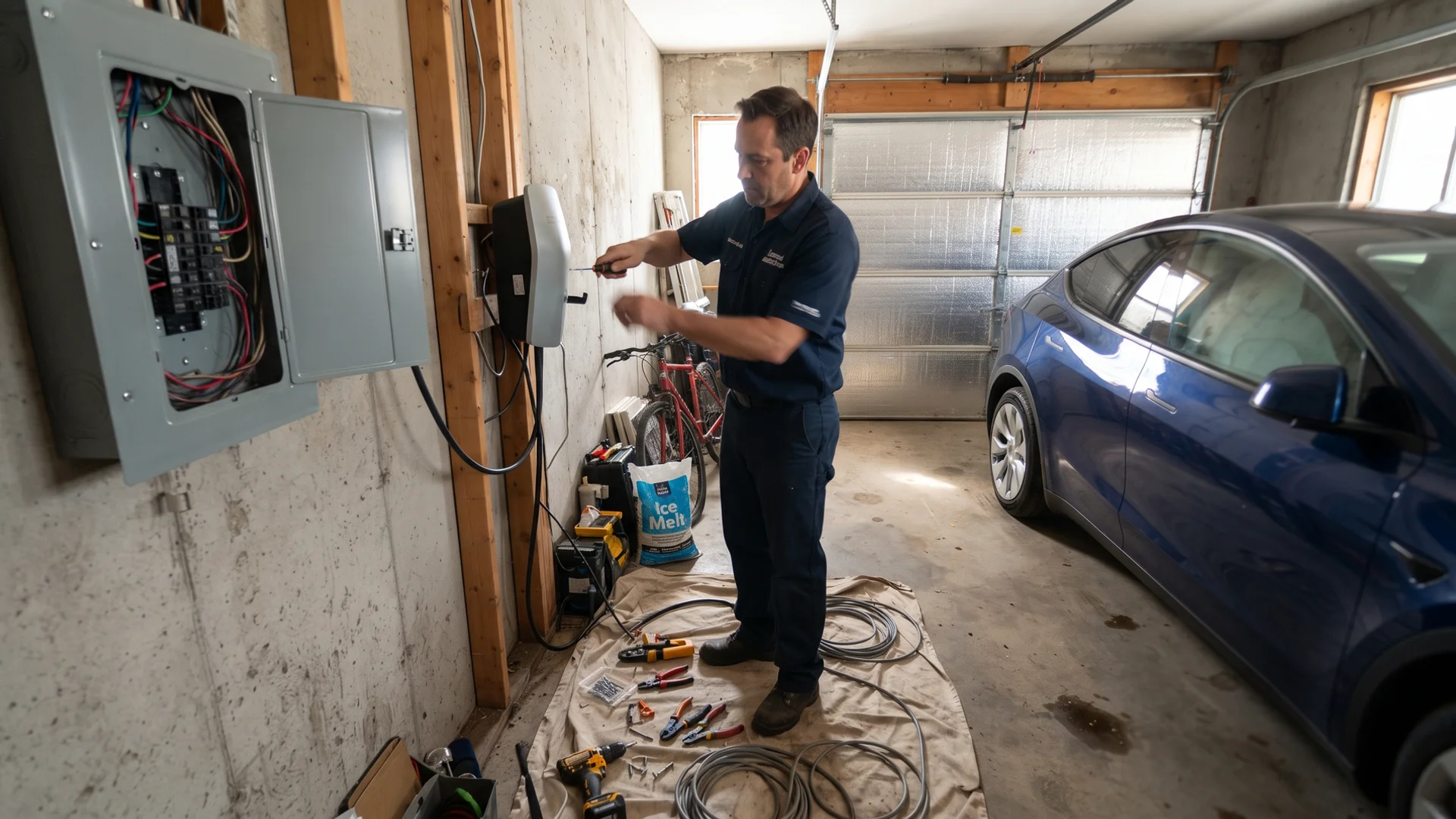
2026 Ontario EV Rebate: up to $5,000 for eligible installations
Toronto EV Charger Installation: Panel Upgrades, Tesla Wall Connector & Ontario EV Rebate in Toronto & Across the GTA
Best EV Charger Installation Toronto provides ESA/ECRA licensed EV charger installation, 100A to 200A electrical panel upgrades, hardwired 240V circuits, NEMA 14-50 outlets, EV Energy Management Systems (EVEMS per OESC Rule 8-106), Tesla Wall Connector Gen 3 commissioning, condo Section 98 charger installs, and 400A residential service upgrades for detached homes, semi-detached homes, townhouses, laneway garages, high-density condominiums, and multi-EV households across the City of Toronto and the Greater Toronto Area. Every install follows OESC Section 8 load calculations and CSA C22.2 continuous-load standards.
According to Ministry of Transportation data, Ontario registered over 100,000 new electric vehicles in 2025 alone, and Ontario Home Renovation Savings (HRS) processed thousands of Level 2 charger rebate applications. Our Master Electrician (309A Construction and Maintenance) leads a WSIB-insured crew with $2M general liability coverage and Toronto Hydro, Alectra Utilities, Elexicon Energy, Oakville Hydro, Burlington Hydro, Milton Hydro, and Newmarket-Tay Power service coordination experience across every GTA region. Standard Level 2 installation runs $1,500 to $2,800 CAD, and $4,000 to $7,300 CAD combined with a 100A to 200A panel upgrade, with DCC-9 and DCC-12 EVEMS load management often saving the panel upgrade cost entirely on qualifying 100A homes.
Whether you need a home garage charger for a Tesla Model 3, Ford F-150 Lightning, Rivian R1T, Hyundai IONIQ 5, Chevy Bolt, or Polestar 2, a shared-parking condo install under Ontario Condominium Act Section 98, or a fleet-scale commercial installation, Best EV Charger Installation Toronto delivers ESA permit filing, Certificate of Acceptance, manufacturer parts warranty registration, and every applicable rebate (Ontario HRS up to $5,000 CAD, Enbridge, Save on Energy, and the federal iZEV vehicle rebate) filed on your behalf. We install Tesla Wall Connector Gen 3, ChargePoint Home Flex, Grizzl-E Classic and Avalanche, JuiceBox Pro, Wallbox Pulsar Plus, and every major SAE J1772 and NACS Level 2 charger brand.
Same-day quote, next-day install. We call you back within 2 hours.
- ✓ ESA/ECRA Licensed Electrical Contractor
- ✓ Master Electrician (309A) on Staff
- ✓ $2M General Liability, WSIB Insured
- ✓ OESC Section 8 Load Calc on Every Quote
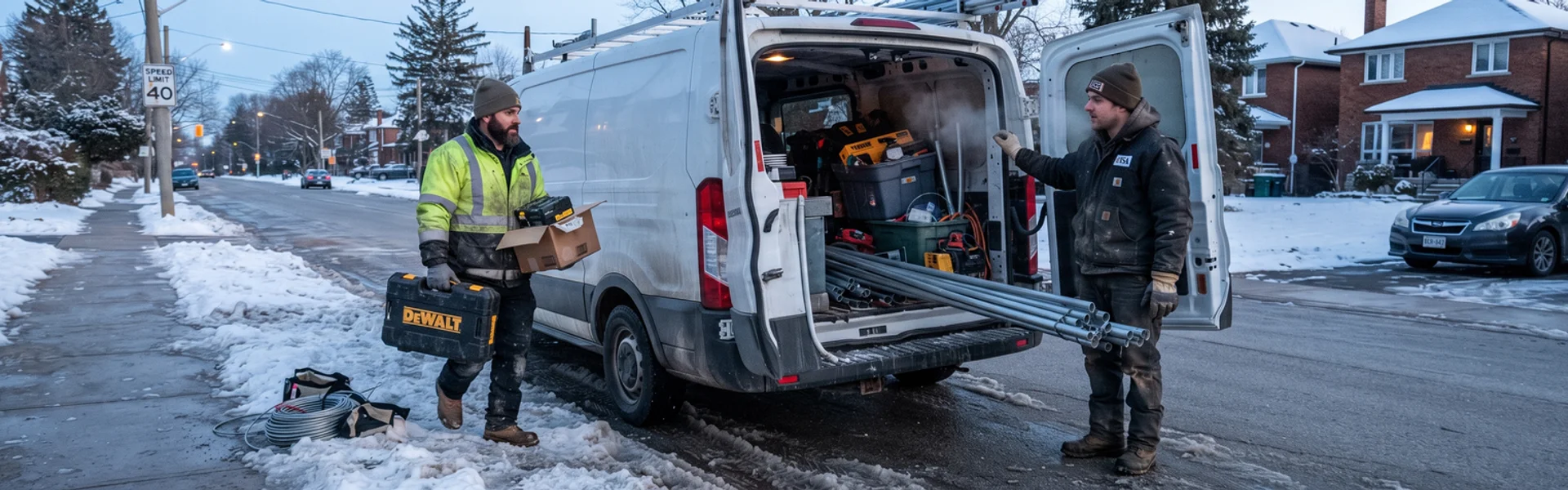
- ✓ Built for Ontario Winter EV Charging
- ✓ Ontario HRS Rebate up to $5,000 Filed for You
Licensing
ESA/ECRA Licensed
Response
Same-day quote, next-day install
Insurance
$2M Liability · WSIB
Rebate
Ontario HRS filed for you
Common Problems
Sound familiar? Common EV charger and panel questions in the GTA
These are the four questions almost every GTA EV owner brings to us. Here is how we settle each one.
Will my panel even handle it?
Most GTA homes built before 2015 run 100A service with a full panel. We settle it with an OESC Section 8 load calculation, not a guess, and quote the cheapest compliant path.
What does ESA actually require?
Every EV charger install in Ontario needs an ESA permit and inspection. We file it, book the inspection, and hand you the Certificate of Acceptance your insurer will ask for.
Where do the hidden costs come from?
Surprise panel upgrades and unpriced trenching are the usual culprits. Our site inspection catches both before you sign, and the written quote is the price you pay.
How do the 2026 rebates work?
The Home Renovation Savings program pays up to $5,000 for an eligible install, but only with an ENERGY STAR charger and an ESA permit. We file the paperwork on your behalf.
Residential EV Charging
Residential EV Charging in Toronto
Level 2 home EV charger installation, Tesla Wall Connector commissioning, dedicated NEMA 14-50 outlets, and same-day repair across Toronto and the GTA. Every install is ESA-permitted, load-calculated to OESC Section 8, and priced fixed in writing before work starts.
View full residential ev charging services overview
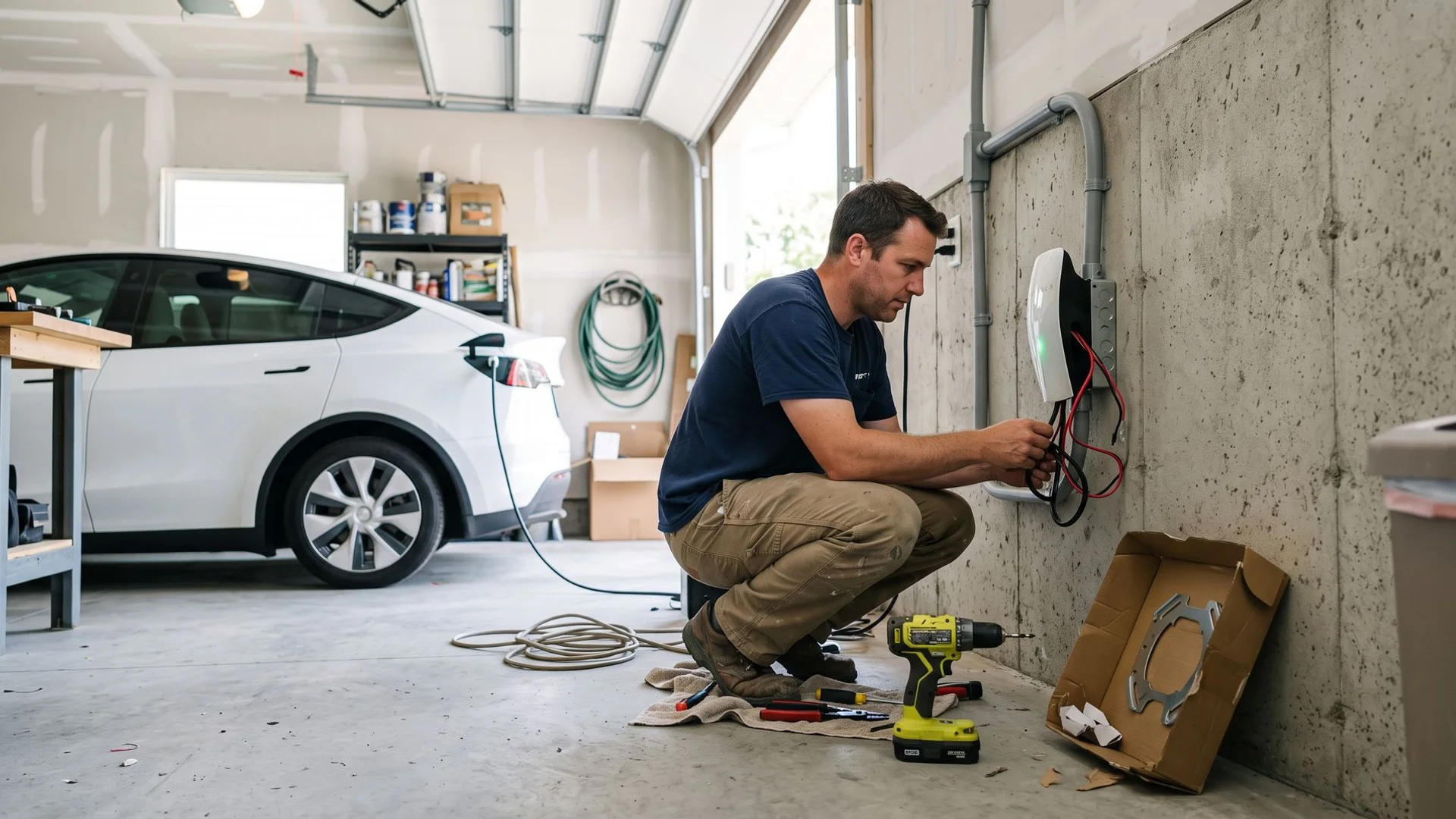
Tesla Wall Connector Installation
Hardwired Tesla Gen 3 and Universal Wall Connector installation on a dedicated 60A circuit for 48A continuous charging, with neutral-free wiring, Wi-Fi commissioning through the Tesla app, and power sharing for households running two Teslas.
Learn more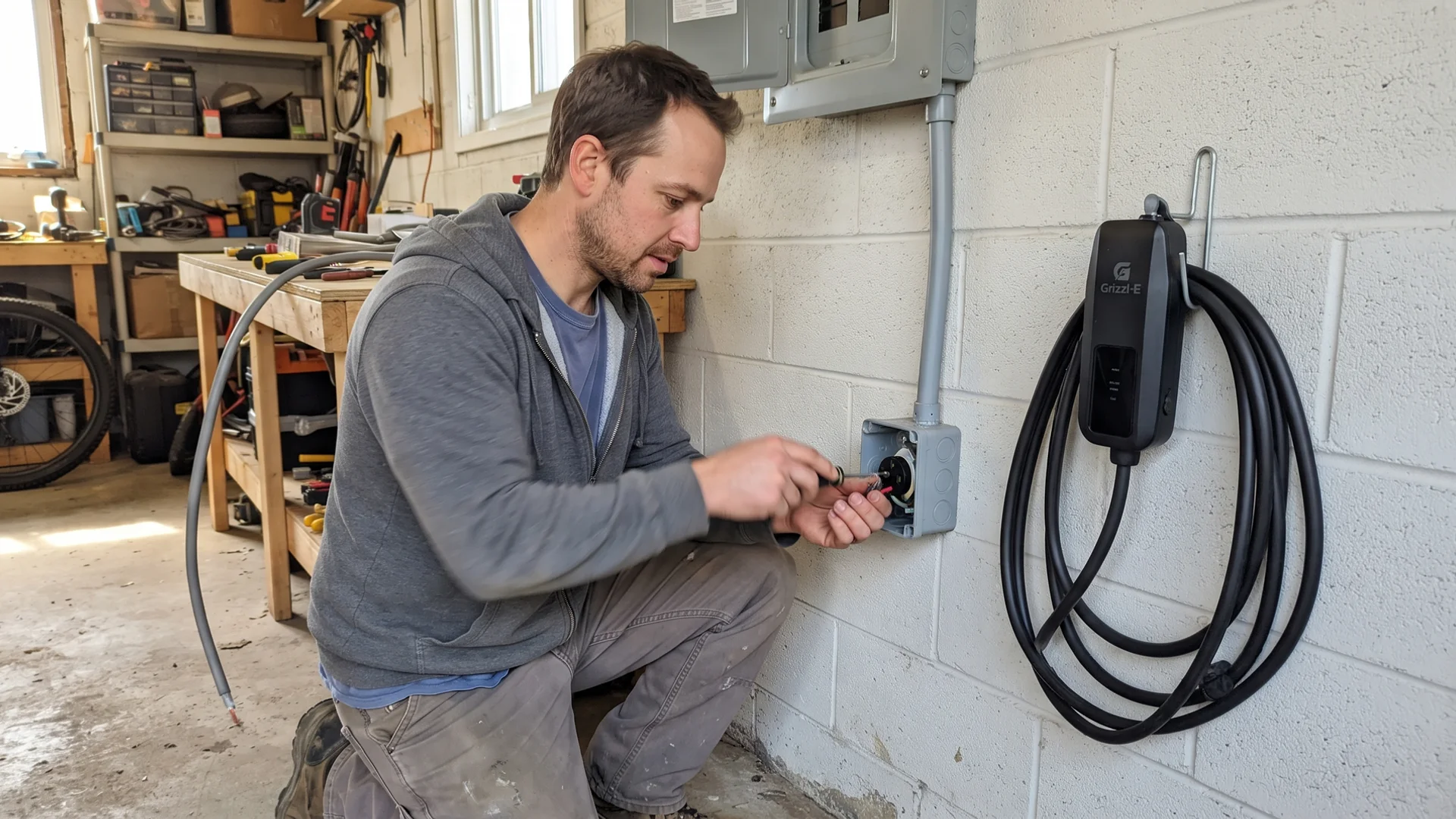
Hardwired 240V Outlet (NEMA 14-50)
Dedicated NEMA 14-50 and NEMA 6-50 receptacle installation on an 8-gauge copper branch circuit with OESC-compliant GFCI protection, sized for portable EV chargers and future hardwired conversion in Toronto homes and condos.
Learn more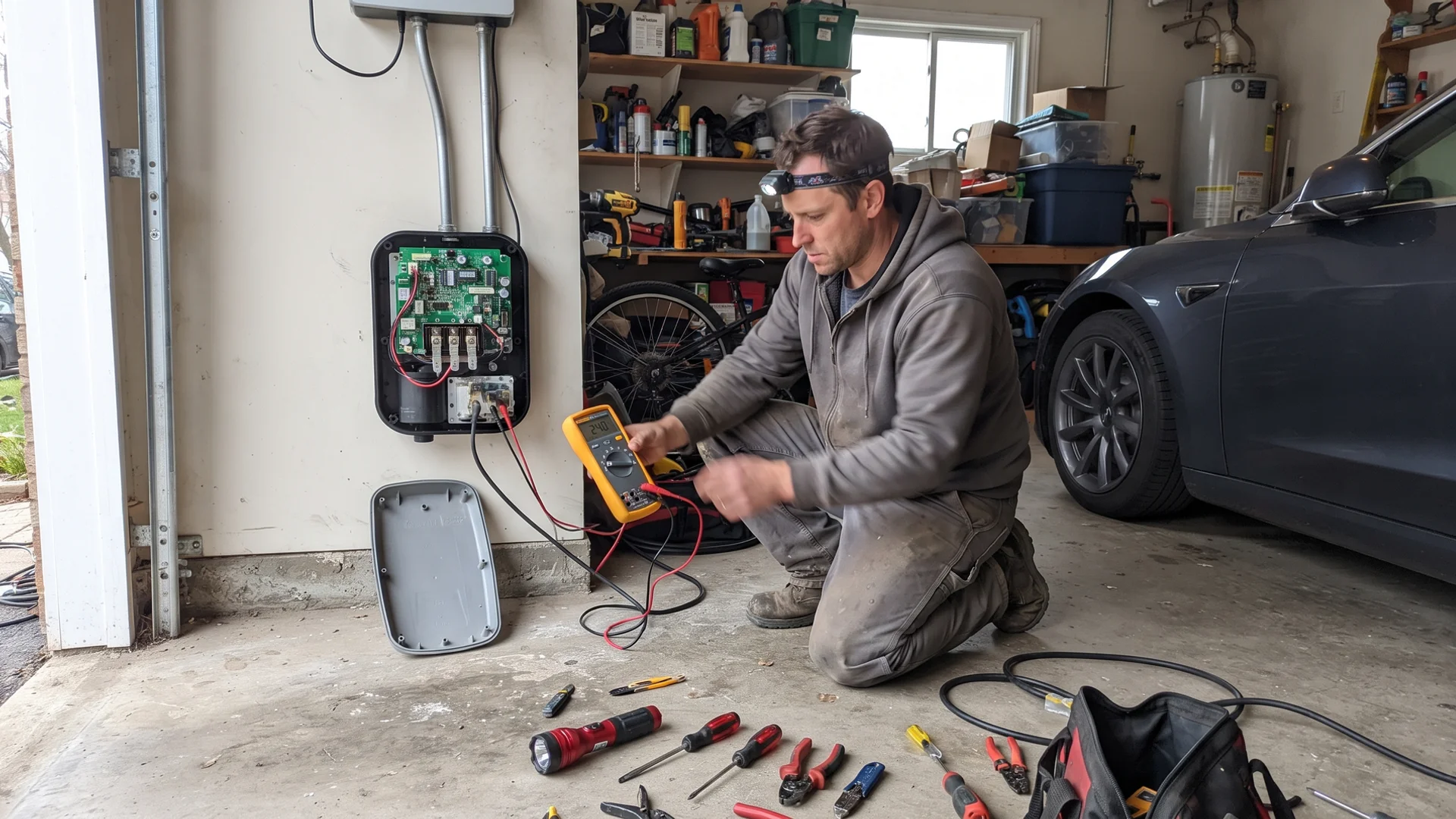
EV Charger Repair & Service
Same-day diagnostic and repair for Grizzl-E, ChargePoint Home Flex, JuiceBox, Wallbox, and Tesla Wall Connectors. GFCI nuisance trip diagnosis, communication faults, ground fault isolation, and overheating connector replacement across the GTA.
Learn more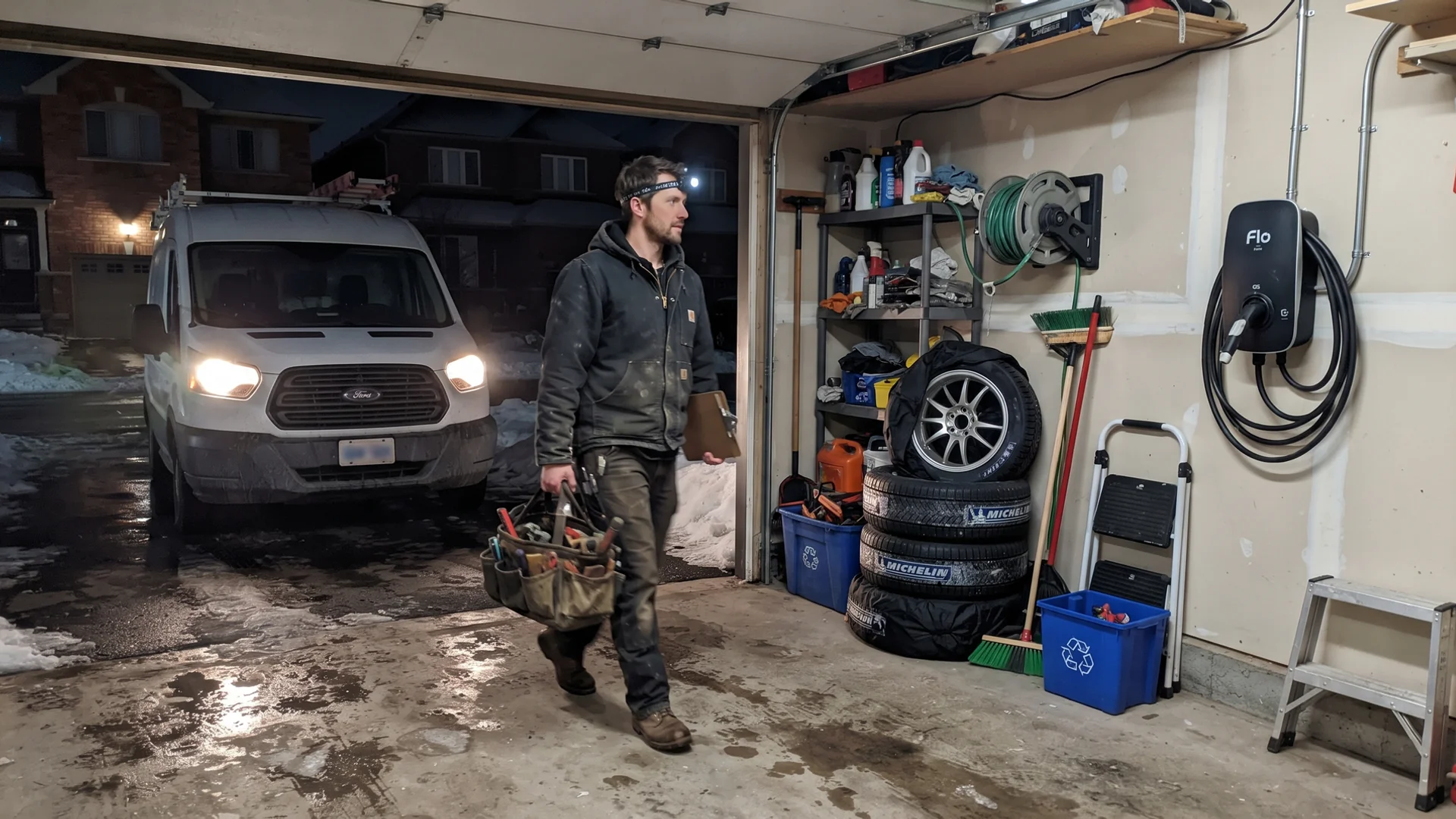
Emergency EV Charger Service
24/7 dispatch for safety-critical EV charger faults: burning smell, sparking, tripped main disconnect, or overheating connector. Isolate the fault, secure the circuit, and get authorized repair scheduled within one business day.
Learn morePanel & Service
Electrical Panel & Service Upgrades
100A to 200A panel upgrades, full 200A service upgrades with mast and meter base replacement, dedicated EV subpanels, and DCC-9 or DCC-12 load management devices. We quote the cheapest OESC-compliant path first, not an automatic panel swap.
View full panel & service services overview
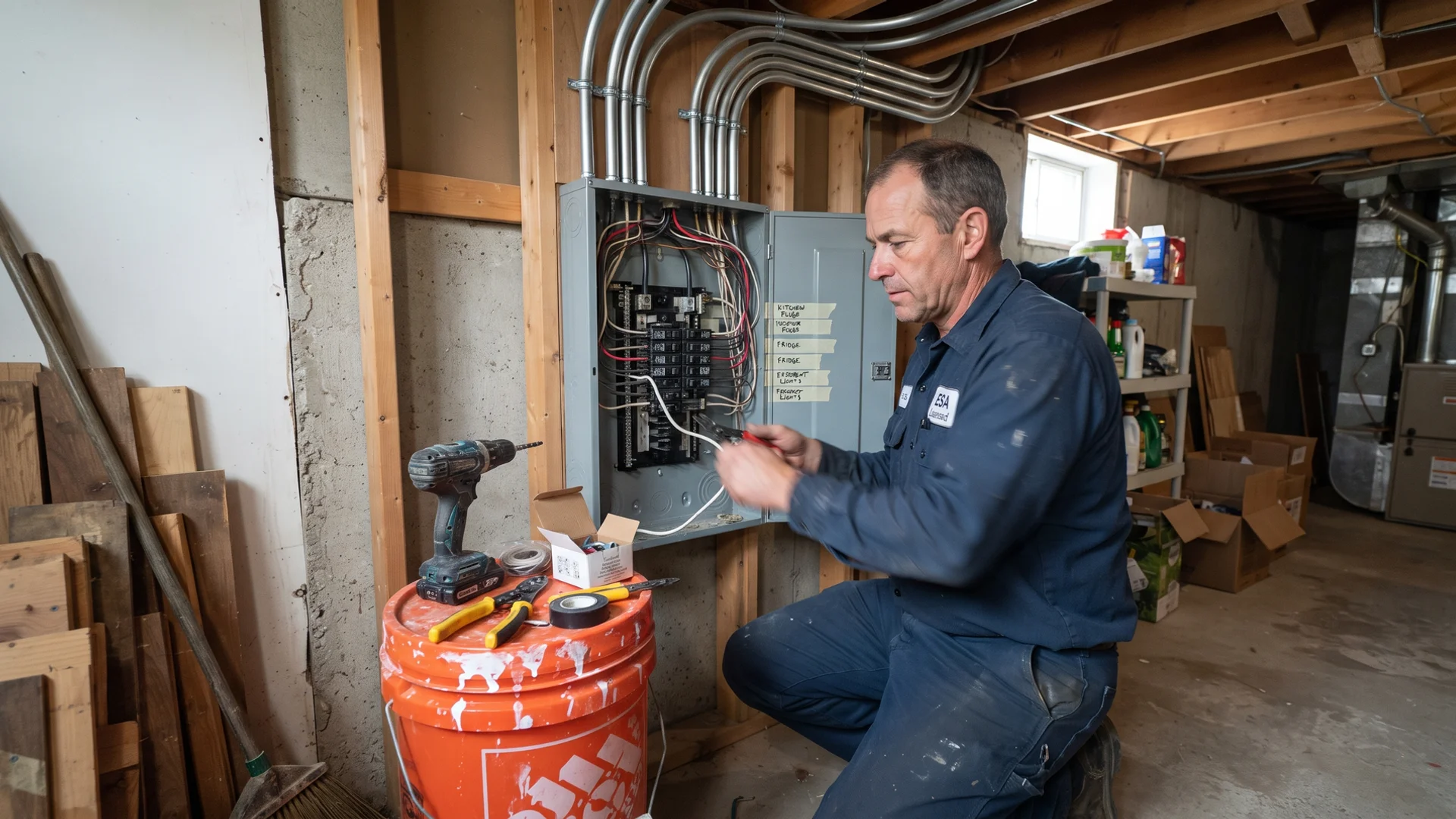
Electrical Panel Upgrade
100A to 200A residential panel replacement with new breakers, bus-bar capacity, OESC Section 8 load calculation, and ESA Certificate of Acceptance. Toronto Hydro or Alectra coordination handled end to end for GTA homeowners.
Learn more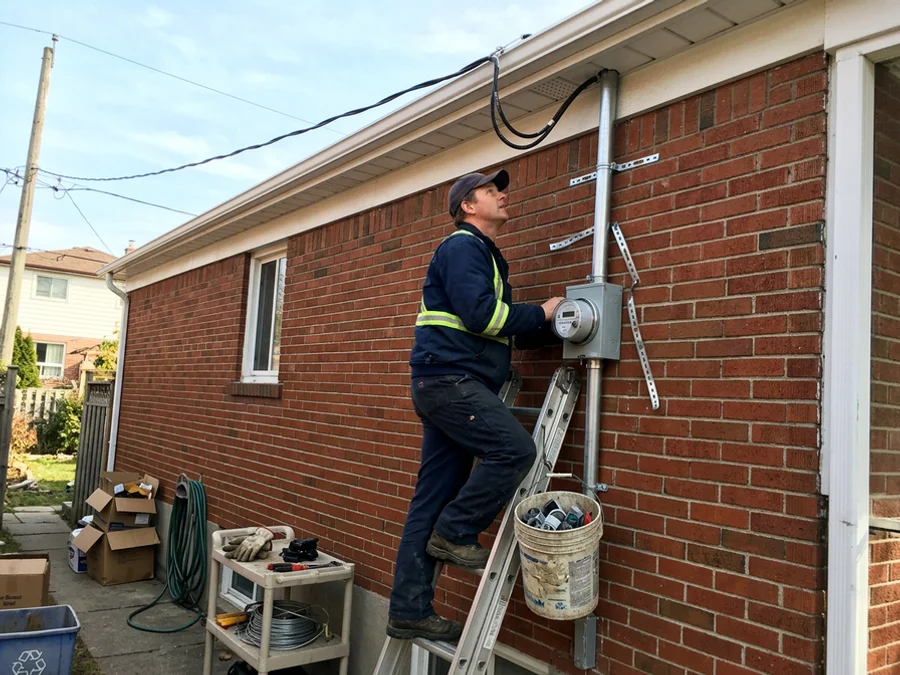
200 Amp Service Upgrade
Full 200A service upgrade including new service mast, meter base, utility point-of-attachment work, whole-home surge protector, copper ground plate, and ESA sign-off, with Toronto Hydro or Alectra disconnect and reconnect coordination.
Learn more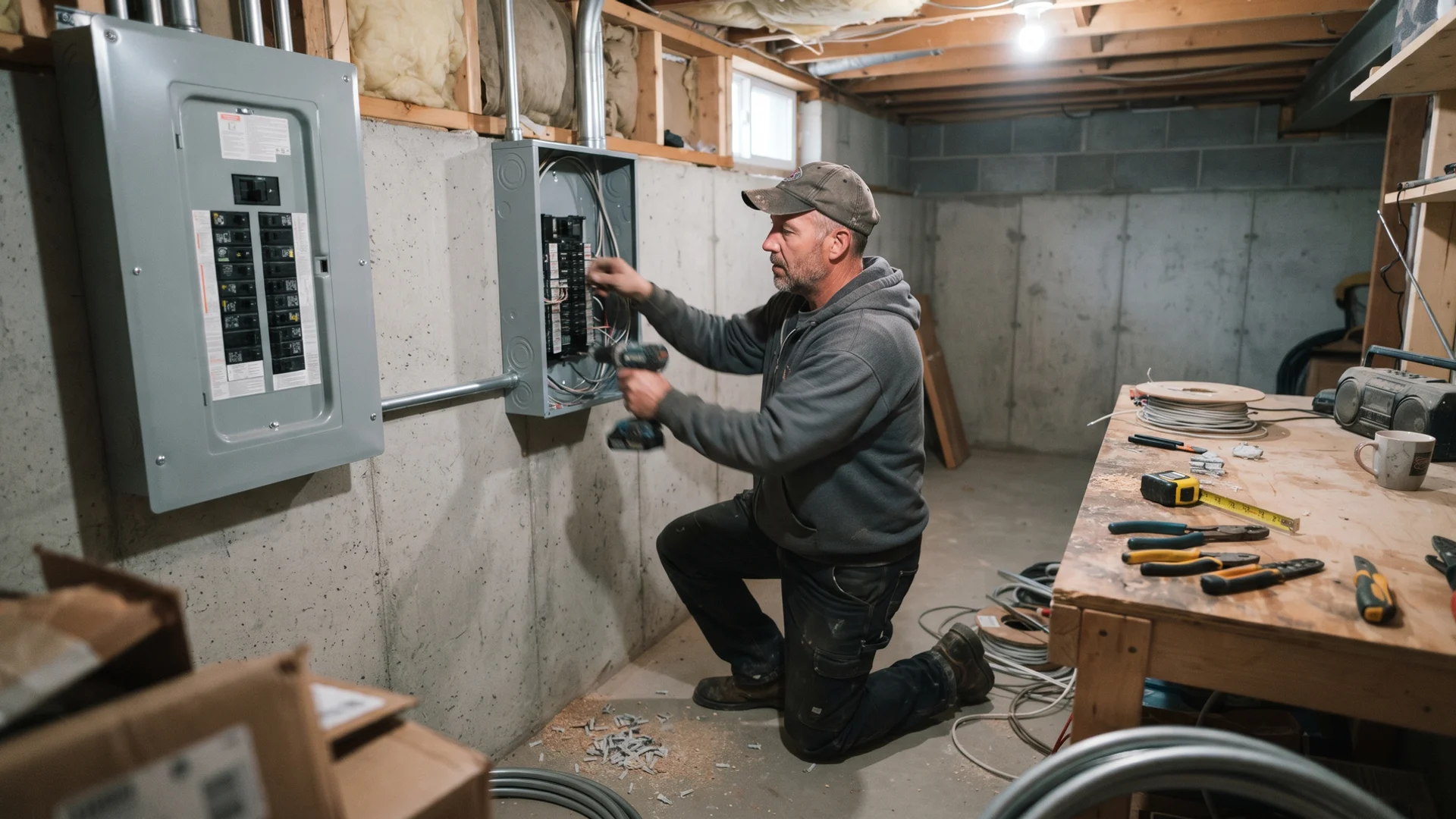
Subpanel Installation for EV
Dedicated EV subpanel installation with correctly sized feeder, isolated neutral and ground, and a double-pole 60A breaker for a hardwired charger. The affordable alternative to a full panel upgrade when your main panel has capacity but no spare breaker space.
Learn more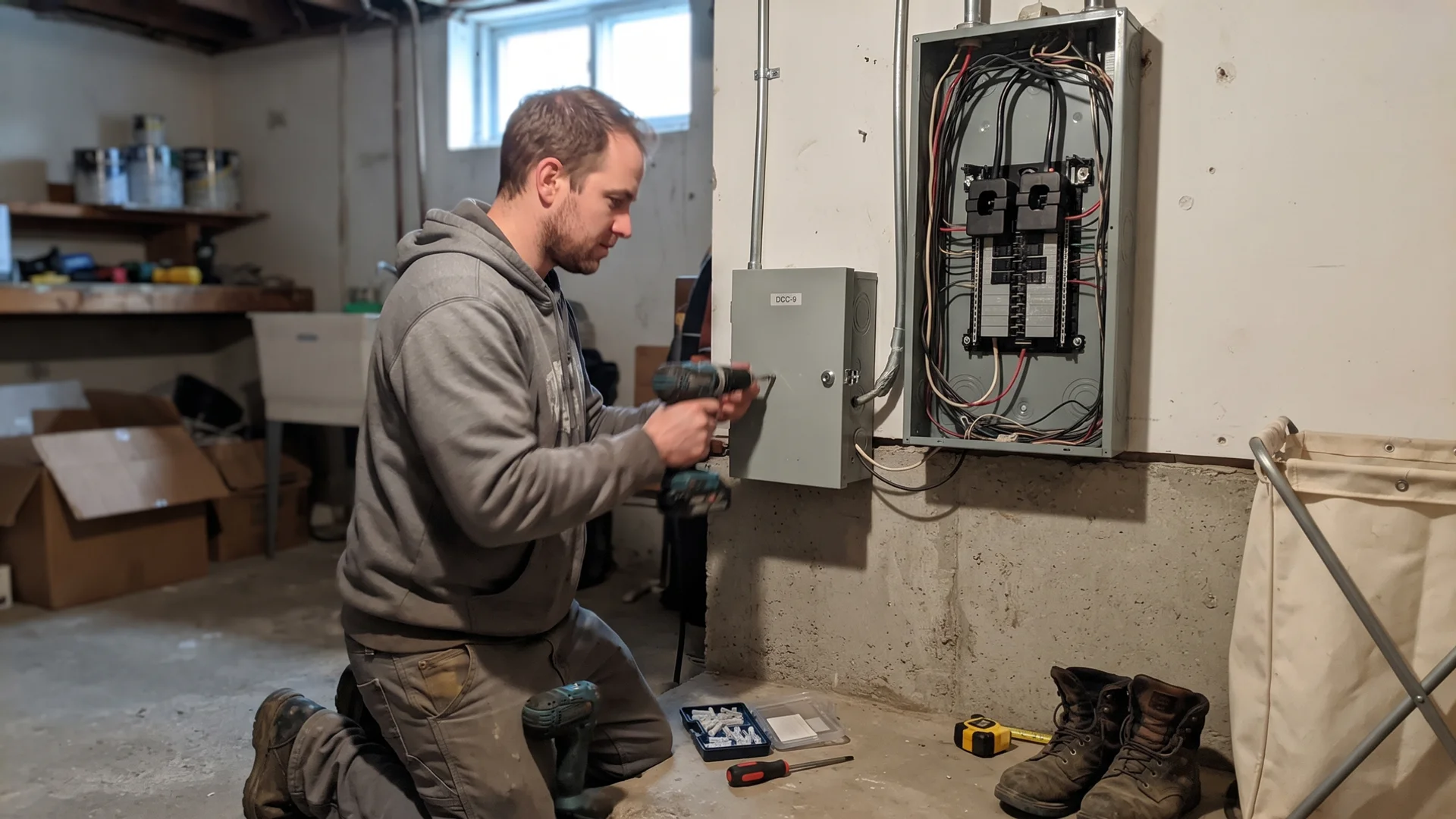
Load Management (EVEMS)
DCC-9, DCC-12, Black Box, and SimpleSwitch EVEMS installation under OESC Rule 8-106, using current-transformer clamps to shed the EV load when household demand peaks. Often adds a Level 2 charger to a 100A panel for a fraction of an upgrade.
Learn moreCondo & MURB
Condo & MURB EV Charging
Ontario Condominium Act Section 98 packages, submetering, and shared-parking installs for condos, townhome corporations, and multi-unit residential buildings across the GTA. We prepare the board documentation, insurance certificate, and technical design.
Commercial
Commercial & Workplace EV Charging
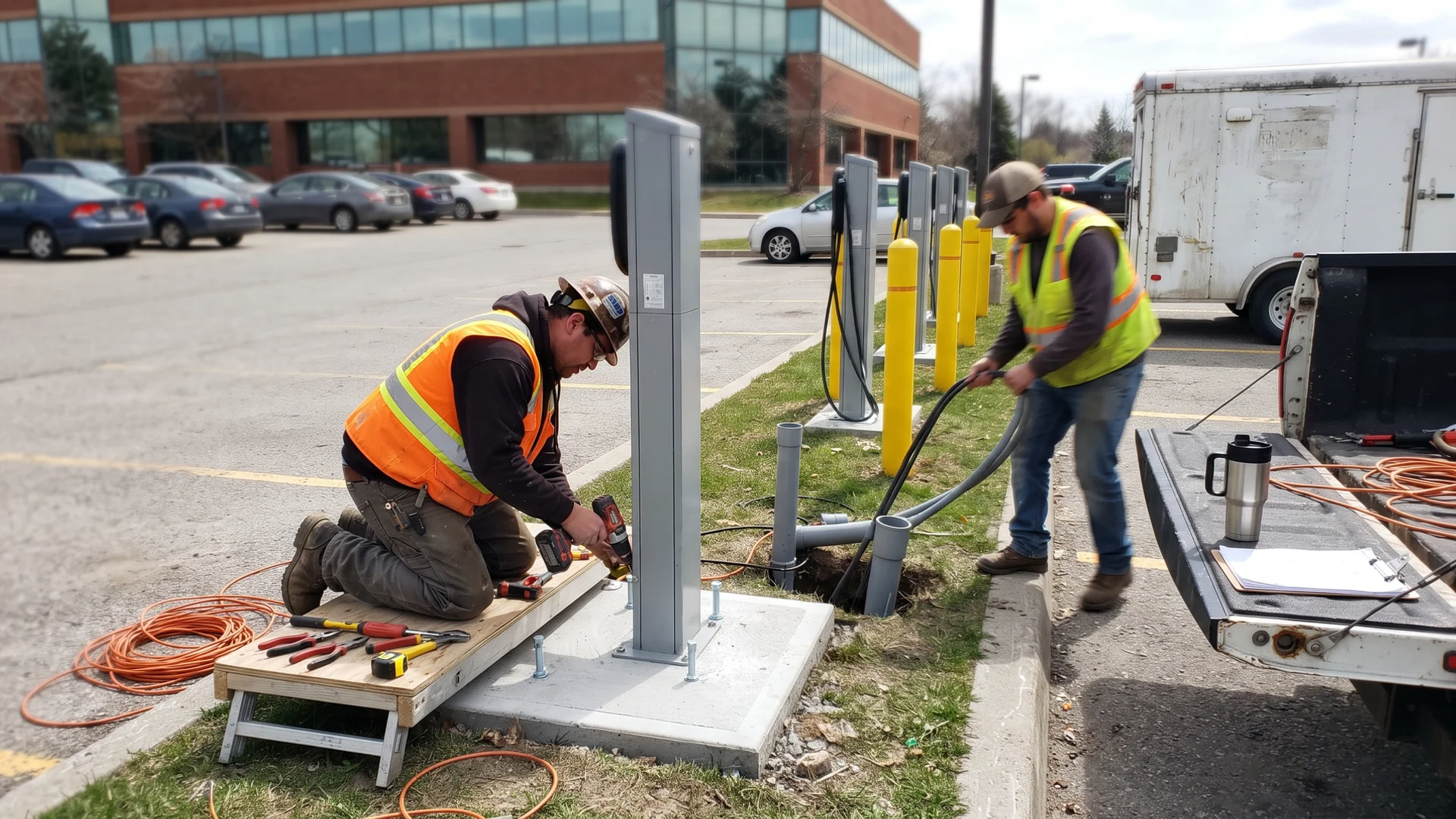
Workplace, retail, and fleet-scale EV charging with OCPP-networked stations, access control, cost recovery, and DC Fast Charger installation on 480-volt three-phase service. ZEVIP-eligible design, demand-charge planning, and turnkey site work.
Rebates & Compliance
Rebates, Permits & Compliance
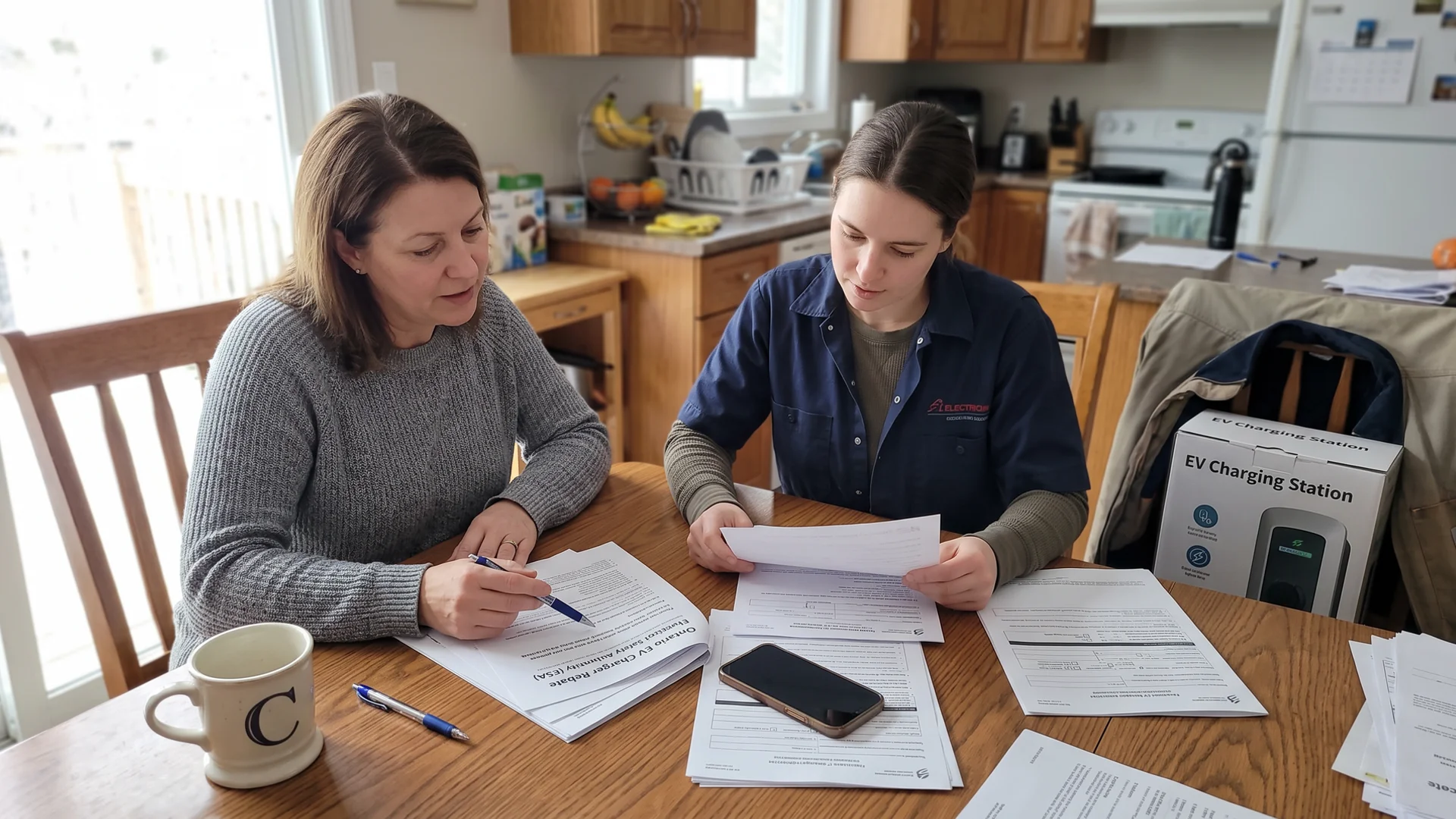
Ontario rebate program filing on your behalf, including the Home Renovation Savings program up to $5,000 CAD, federal iZEV coordination with your dealership, Enbridge and Save on Energy stacking, and full ESA permit and inspection documentation.
Highest demand
Featured EV charger & panel services
The scopes we quote most across the GTA every week. Full catalogue above covers all 11 services and every family page.
Electrical Panel Upgrade
100A to 200A residential service upgrades that give your home the capacity to charge an EV, with ESA permit filing and Toronto Hydro coordination.
Tesla Wall Connector Installation
Gen 3 Tesla Wall Connector installation with load sharing for multi-Tesla households and NACS to J1772 adapter support for other EVs.
Condo EV Charger Installation
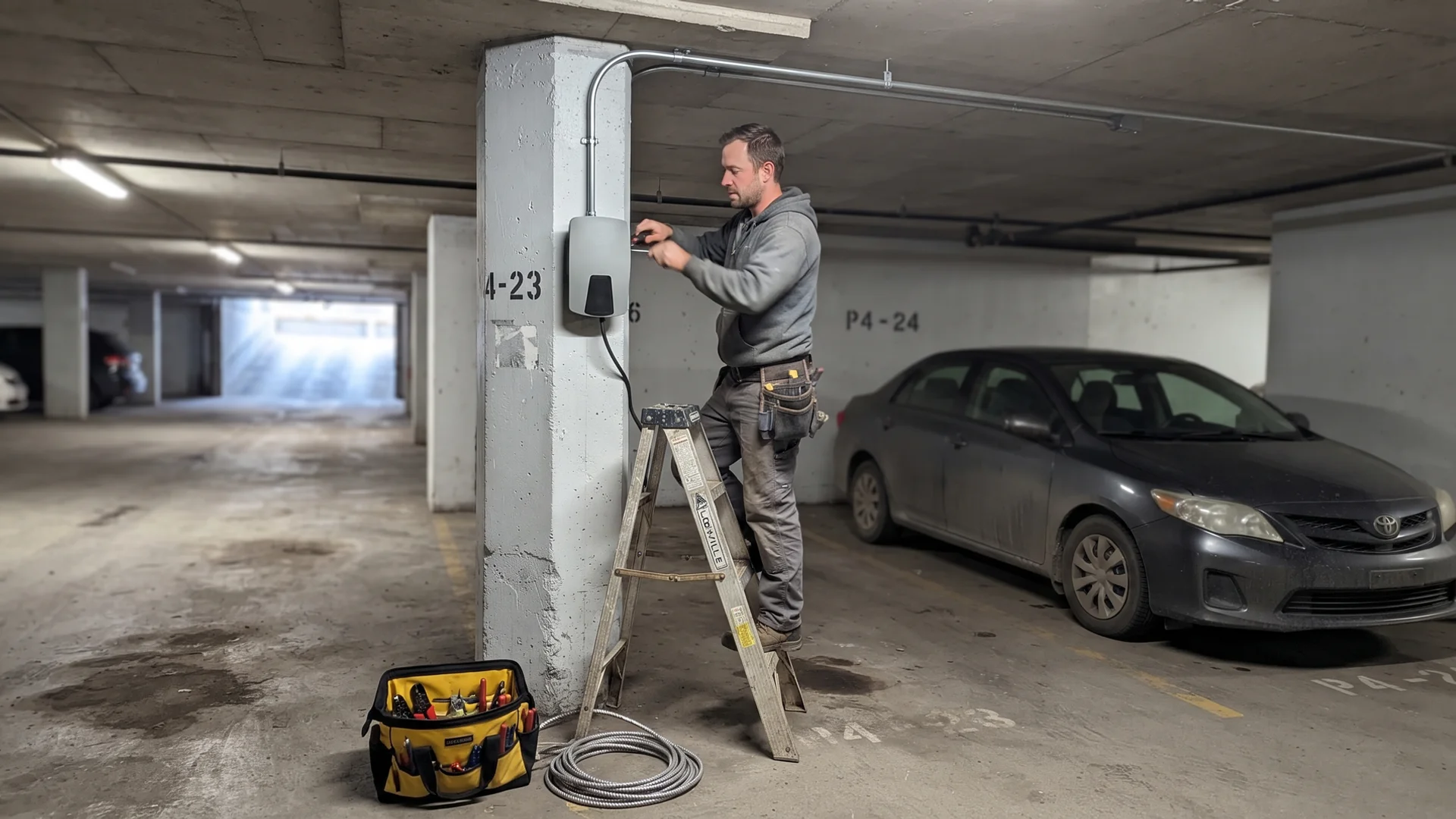
Section 98 board approval, submetering, and load management for condo owners installing EV chargers in shared parking.
Load Management System (EVEMS) Installation
Smart load management (EVEMS) that lets a capacity-constrained panel power an EV charger without a full upgrade, compliant with OESC Rule 8-106.
Hardwired 240V Outlet Installation (NEMA 14-50)
NEMA 14-50 or 6-50 dedicated 240V outlet on a GFCI branch circuit, ready for a portable EV charger and popular with renters.
Repairs, subpanels, commercial sites, rebate filing, and 24/7 emergency service are also available.
Chargers We Install
EV charger brands we install and service across the GTA
- Tesla
- ChargePoint
- Grizzl-E
- JuiceBox
- Wallbox
- Emporia
- Enel X
- Sun Country Highway
- FLO
- Autel
- Siemens VersiCharge
EV Charging Across the Greater Toronto Area
The City of Toronto has a population exceeding 2.9 million residents, and the Greater Toronto Area now exceeds 7 million people across Peel, Halton, York, and Durham Regions. Continued residential EV adoption throughout Toronto, North York, Etobicoke, Scarborough, East York, Mississauga, Brampton, Vaughan, Markham, Richmond Hill, Oakville, Burlington, Milton, Ajax, Pickering, Whitby, Oshawa, Newmarket, and Aurora has driven demand for ESA-permitted Level 2 charger installation and 100A to 200A residential panel upgrades to modern GTA housing stock.
Older neighbourhoods across the GTA including The Beaches, Riverdale, Leslieville, High Park, The Annex, Rosedale, Yorkville, Willowdale, The Kingsway, Mimico, Long Branch, Agincourt, Guildwood, Birch Cliff, Woodbridge, Kleinburg, Unionville, Oak Ridges, Bronte, Glen Abbey, and Old Milton contain aging 60A and 100A electrical services that benefit from 200A panel upgrades and OESC Section 8 load calculations before adding a dedicated 40A or 60A Level 2 charger circuit. Modern subdivisions in Cornell, Berczy Village, Alton Village, Duffin Heights, and Seaton typically ship with 200A service ready for straight-swap Level 2 installation.
Free Tools
Not ready to call? Try a free tool first
Check your panel capacity or find the right service in under three minutes. No signup required to see your result.
Calculator
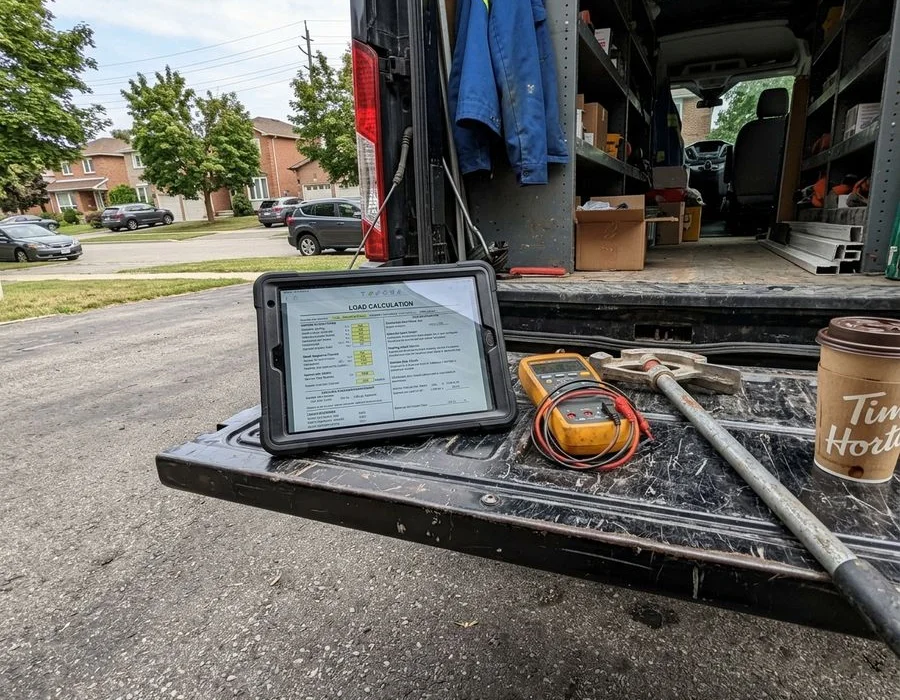
Electrical Load Calculator
Calculate if your electrical panel can handle an EV charger and your other appliances, or if you need an upgrade.
Try it now →Quiz
Electrical Service Finder
Answer a few questions to find the right electrical or EV charging service for your situation.
Try it now →Complete Guide
EV charger installation, permits, rebates & vehicle scenarios for Toronto & the GTA
Everything a Toronto or GTA EV owner needs to know before booking an install, from cost bands and ESA permit requirements to vehicle-specific setups for Tesla, Ford Lightning, Rivian, and Hyundai IONIQ 5.
How much does EV charger installation cost in Toronto?
A standard Level 2 hardwired home EV charger installation in Toronto runs $1,500 to $2,800 CAD when your panel has spare capacity for a dedicated 40A or 60A circuit. That price band covers the charger install labour, the dedicated branch circuit, the ESA permit, the inspection, and the Certificate of Acceptance.
Where the number moves up: adding a 100A to 200A panel upgrade brings combined charger plus panel work to $4,000 to $7,300 CAD. Adding a full 200A service upgrade with new mast and meter base runs $5,000 to $8,300 CAD combined. Adding a dedicated EV subpanel (when the main panel has kW capacity but no breaker space) adds $1,500 to $2,800 CAD.
Where the number moves down: a DCC-9 or DCC-12 EVEMS load management device under OESC Rule 8-106 often lets a 100A home add a Level 2 charger without a panel upgrade for $500 to $1,200 CAD extra, saving $2,000 to $4,000 CAD versus the upgrade. Home Renovation Savings rebate up to $5,000 CAD is filed on your behalf on qualifying installs and often returns more than the install cost itself.
Do I need an ESA permit to install an EV charger in Ontario?
Yes. Every EV charger installation in Ontario requires an Electrical Safety Authority permit and inspection under the Ontario Electrical Safety Code. That applies to hardwired chargers and to dedicated 240V receptacles like NEMA 14-50 or NEMA 6-50 that are installed specifically to power a portable EV charger.
The permit is filed by the licensed electrical contractor (that is us) at the time of quote or at the start of install. The ESA inspector attends after the work is complete, typically within 24 to 72 hours, and issues a Certificate of Acceptance that documents the work as OESC-compliant.
That Certificate of Acceptance matters in three places downstream: your home insurance provider will ask for it on any renewal or claim involving electrical work, your future buyer's lawyer will ask for it during the sale close, and every Ontario rebate program (HRS, Enbridge, Save on Energy) requires it as proof of compliant install. Skipping the permit saves $150 to $250 CAD upfront and costs $5,000 CAD in eligible rebates plus potential insurance and resale exposure downstream.
How long does EV charger installation take?
The on-site install for a standard Level 2 hardwired scope takes 2 to 4 hours from arrival to commissioning. That includes running the dedicated 40A or 60A circuit from panel to mounting location, mounting the charger, landing the wiring, torqueing the breaker, commissioning through Wi-Fi where applicable, and verifying a live charge session with the vehicle.
The end-to-end timeline from first phone call to energized charger looks like: call before 2pm for a same-day quote, install the next day for standard scope. Panel upgrade jobs add 1 day for the swap plus 24 to 72 hours for ESA inspection to close the file. Full service upgrade jobs add 1 to 2 weeks because Toronto Hydro, Alectra, Oakville Hydro, Burlington Hydro, or Elexicon Energy has to coordinate a disconnect and reconnect around the install date.
Where timelines stretch beyond the standard: condo Section 98 approvals typically take 4 to 8 weeks depending on board meeting cadence, custom outdoor installs with trenched feeders to detached garages add 1 to 2 days for the trench work, and commercial workplace installs with 8 or more stations run 3 to 6 weeks from site walk to commissioning depending on load management integration.
Hardwired vs plug-in EV charger installation: which is better?
Hardwired Level 2 chargers deliver 40A or 48A continuous output (9.6 to 11.5 kW at 240V) directly from the branch circuit into the charger enclosure, with no receptacle in the path. Plug-in chargers connect through a NEMA 14-50 or NEMA 6-50 receptacle at up to 40A rated (32A continuous under OESC continuous-load rules).
The hardwired path delivers 50 percent more throughput on the top-tier units, eliminates GFCI double-detection nuisance trips that some receptacle installations experience, and integrates more cleanly with load management (EVEMS) devices because there's no receptacle interlock to work around. It's the right buy for a homeowner staying in the property for 5 or more years.
The plug-in path via a NEMA 14-50 or 6-50 receptacle wins in three scenarios: you rent (the receptacle stays with the property), you plan to move within 5 years and want to take the charger to the next home, or you want the flexibility to swap between chargers or share with a shop tool that expects a 14-50 receptacle. Cost for the receptacle install is $800 to $1,500 CAD plus your $250 to $600 CAD portable Level 2 charger.
What certifications does an EV charger installer need in Ontario?
Any company installing electrical work in Ontario, including EV chargers, must be an ESA/ECRA licensed electrical contractor. ESA (Electrical Safety Authority) is the regulator that issues permits and inspects work; ECRA (Electrical Contractor Registration Agency) is the licensing body that registers contractors.
Individual electricians on the job must hold a Certificate of Qualification. The relevant trade is 309A Construction and Maintenance Electrician, colloquially the "Master Electrician" designation. Apprentices work under a licensed 309A journeyperson at a defined ratio. Companies that install EV chargers should have at least one 309A on staff, ideally the person signing the permits.
Insurance and coverage should include WSIB (Workplace Safety and Insurance Board) for every technician on site, general liability at $2M minimum, and bonded contractor status. Ask for the ESA/ECRA contractor number, the 309A holder name, the WSIB clearance certificate, and the Certificate of Insurance. Legitimate contractors provide all four on request. Best EV Charger Toronto carries all four current and provides documentation for any commercial or Section 98 install package.
Level 1 vs Level 2 EV charging at home explained
Level 1 charging uses a standard 120V household outlet, typically 15A, delivering roughly 1.4 kW to the vehicle. Every EV ships with a Level 1 mobile charger from the factory. Charge rate on a Level 1 setup is 6 to 8 kilometres of range per hour, so a full daily-driver charge takes 15 to 30 hours depending on battery size.
Level 2 charging uses a dedicated 240V circuit at 30A to 60A, delivering 7.2 kW to 11.5 kW. Charge rate on a Level 2 setup is 35 to 55 kilometres of range per hour, so a full daily-driver charge takes 4 to 8 hours. That fits inside an overnight window with margin.
For any daily-driver EV, Level 2 is the correct answer. Level 1 works only as a supplemental top-up for very short commutes or as a backup during Level 2 downtime. The vehicle onboard charger limits the maximum Level 2 rate: Tesla Model 3 Long Range accepts 11.5 kW, Ford Mustang Mach-E accepts 11.5 kW, Hyundai IONIQ 5 accepts 10.9 kW, most PHEVs cap at 3.7 kW to 6.6 kW. Our load calculation matches the circuit sizing to the vehicle acceptance rate, so you don't pay for a 60A circuit if your vehicle can only draw 40A.
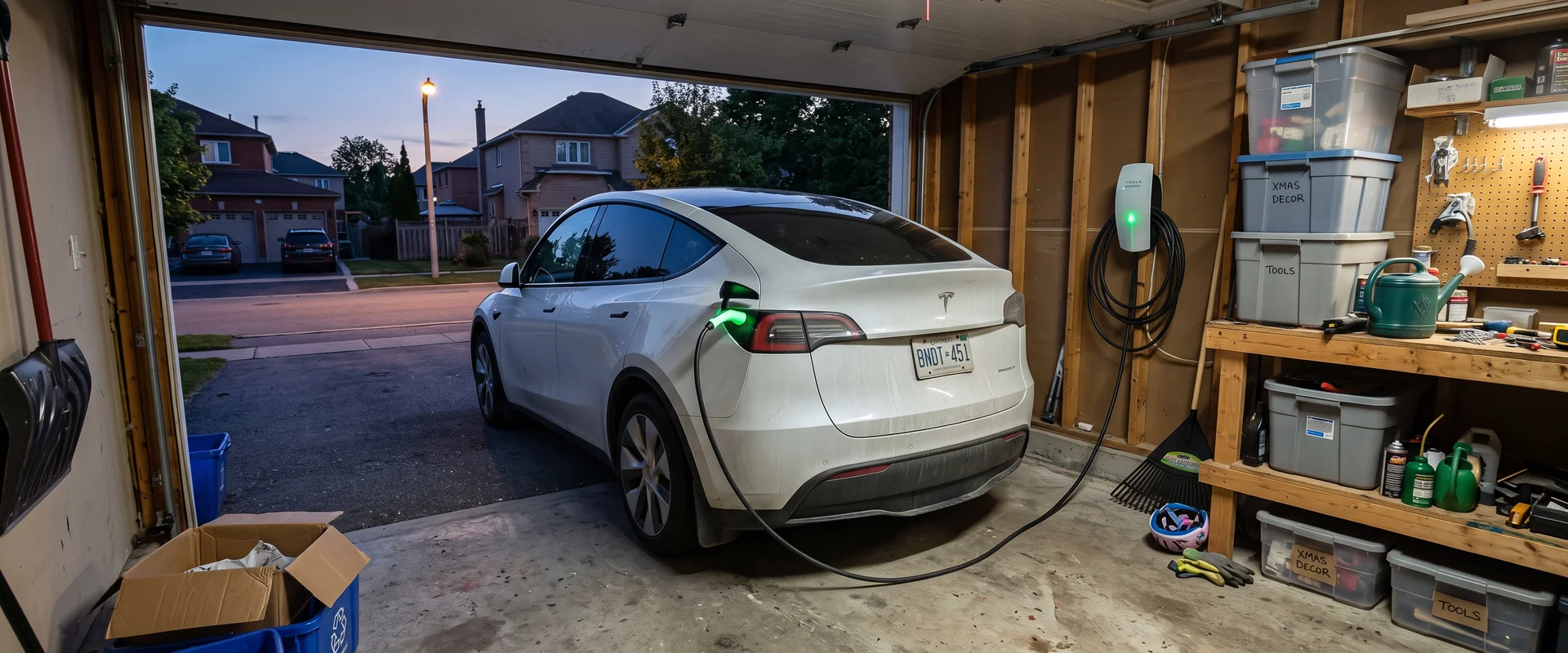
Tesla home charger installation in Toronto
Tesla vehicles use the North American Charging Standard (NACS) connector, formalized as SAE J3400, and the natural home pairing is a Tesla Wall Connector Gen 3 hardwired on a 60A circuit for 48A continuous output. That configuration delivers 11.5 kW at 240V, which is the maximum a Model 3 Long Range, Model Y Long Range, Model S, or Model X can accept through its onboard charger.
Standard Toronto install for a Tesla Wall Connector runs $1,800 to $2,800 CAD covering the hardwired install, dedicated 60A circuit, ESA permit, and commissioning through the Tesla app. Two-Tesla households can use Wall Connector power sharing to run two units on a single 60A circuit, saving the second circuit and often the panel upgrade that would otherwise be required.
The Universal Wall Connector variant includes a built-in J1772 adapter for households with mixed Tesla and non-Tesla EVs, for an $80 to $100 CAD premium over the Gen 3. See our full Tesla Wall Connector installation page for spec details, mounting guidance, and pricing tiers.
Ford F-150 Lightning charger installation in Toronto
The Ford F-150 Lightning uses a J1772 connector for AC (Level 1 and Level 2) charging and accepts up to 19.2 kW on Level 2 when paired with a compatible high-amperage charger. The standard match is a hardwired Level 2 charger on a 60A circuit for 48A continuous output at 11.5 kW, which is what most homes support without a service upgrade.
The F-150 Lightning Extended Range trim ships with the Ford Charge Station Pro, an 80A hardwired charger that can deliver up to 19.2 kW when paired with a 100A dedicated circuit. That's a heavier install: 100A double-pole breaker, 3-gauge copper conductors, and load calculations that assume the vehicle is drawing continuously. On most existing 100A residential services, this is not achievable without a 200A service upgrade first.
The Charge Station Pro also supports Ford Intelligent Backup Power, which uses the truck's traction battery to power the home during grid outages. That capability requires a Ford Home Integration System (transfer switch, gateway, and inverter) and typically 6 to 12 months lead time on installer availability. We handle the electrical side of the install; the Ford software and system components are integrated by Ford-certified partners.
Rivian R1T and R1S charger installation in Toronto
Rivian R1T (truck) and R1S (SUV) currently use a J1772 connector for AC charging with acceptance up to 11.5 kW on Level 2. Rivian has publicly committed to a NACS transition for future model years but current production remains J1772 on AC.
The natural home install is a hardwired Level 2 charger on a 60A circuit delivering 48A continuous. Any of the ENERGY STAR certified units work well: ChargePoint Home Flex, Grizzl-E Avalanche, JuiceBox Pro 40, Wallbox Pulsar Plus, or the Rivian Wall Charger. Standard Toronto install runs $1,500 to $2,800 CAD.
The Rivian Wall Charger is worth calling out because it offers 48A continuous, RFID and app control, integrates natively with the Rivian mobile app for charge scheduling and cost tracking, and comes with a $50 CAD/year premium for network features. For Rivian-only households the native integration is worth the small premium; for mixed households a brand-neutral unit is fine.
Hyundai IONIQ 5 and IONIQ 6 charger installation in Toronto
Hyundai IONIQ 5 and IONIQ 6 both use J1772 for AC charging with acceptance up to 10.9 kW (48A continuous on a 60A circuit). Both vehicles use CCS1 for DC Fast Charging with acceptance up to 233 kW on the IONIQ 5 and 350 kW on the IONIQ 6 platform where public DCFC infrastructure supports it.
For home charging, a standard Level 2 hardwired install on a 60A circuit is the right pairing. Any ENERGY STAR certified unit works. Cost is the standard $1,500 to $2,800 CAD Toronto install. The vehicle's 10.9 kW acceptance rate means the circuit runs at ~45A continuous rather than the full 48A, but that's a minor rate difference in practice.
IONIQ 5 and 6 both support Vehicle-to-Load (V2L) through the onboard 3.6 kW inverter, letting you power tools, appliances, or an emergency portable AC from the vehicle battery via a special adapter. That capability doesn't affect the home charger install directly but is worth knowing about when planning your home electrical infrastructure. Some IONIQ 5 owners install a dedicated outdoor 240V receptacle specifically to plug the V2L adapter into a home-grid interconnect, which requires additional load calculations.
2026 Ontario EV rebates and how they lower your install cost
The current Ontario rebate stack for a home EV charger installation includes Home Renovation Savings up to $5,000 CAD for the charger, Enbridge EV Charger Rebate up to $1,000 CAD for Enbridge Gas customers, Save on Energy variable incentives depending on the utility program cycle, and federal iZEV up to $5,000 CAD on the vehicle purchase at point-of-sale.
On a typical $1,800 CAD Level 2 install, the HRS rebate alone more than covers the install cost, leaving a net negative out-of-pocket for the charger portion. Combined with the federal iZEV rebate on the vehicle, a household buying a new EV and installing home charging in 2026 can see combined rebates exceed $11,000 CAD.
Eligibility requires an ENERGY STAR certified charger from the approved product list, an ESA permit with Certificate of Acceptance, and typically a pre and post installation EnerGuide evaluation for the HRS program. We file the paperwork on your behalf at no additional cost, so the rebate cheque or direct deposit lands in your account 8 to 12 weeks after install. See our full 2026 Ontario EV rebate guide for filing details, program specs, and stacking sequences.
Why Choose Us
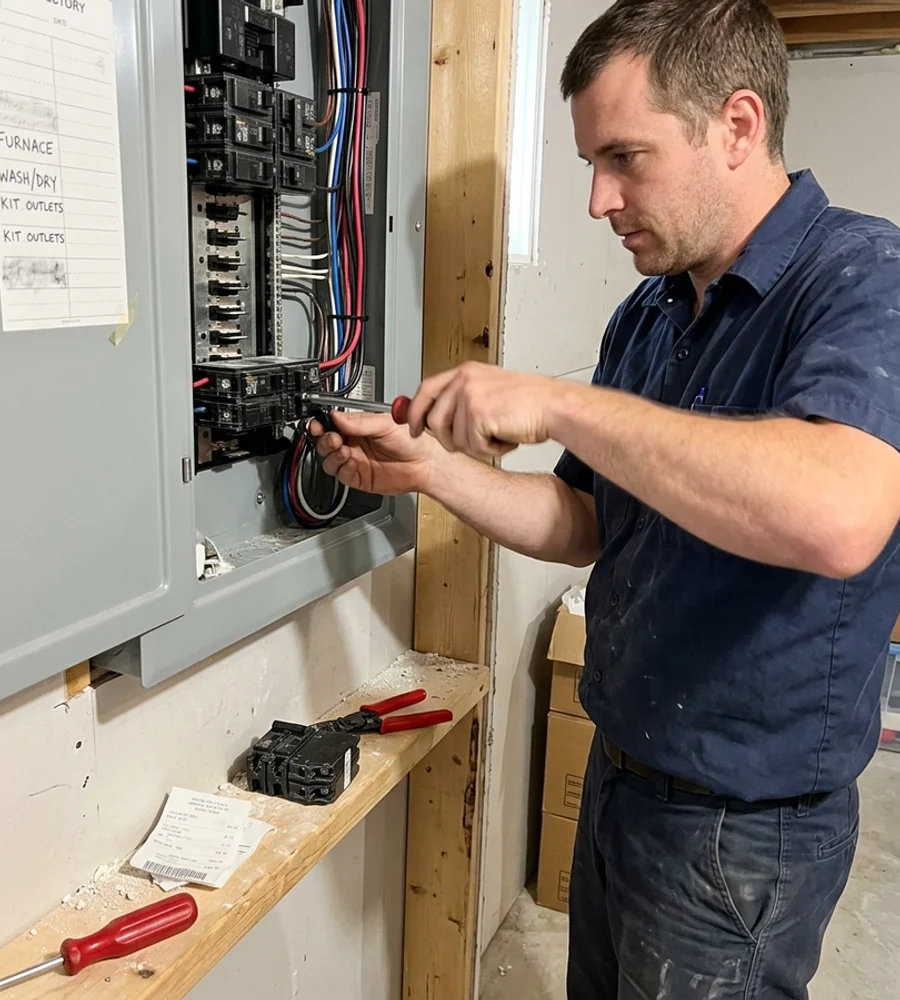
Why GTA homeowners hand us the panel keys
We are a dedicated EV charging and panel-upgrade crew working across Toronto, Peel, York, Halton, and Durham. Here is what that means in practice.
EV charging specialists, not general electricians
Chargers and panel upgrades are all we do. That means we know the difference between a Tesla Gen 3 Wall Connector, a Grizzl-E Avalanche, and a ChargePoint Home Flex without looking it up, and we know which one suits your service size.
Same-day quote, next-day install
Call before 2pm and you get a quote by end of day. Standard Level 2 scope is installed the next day. We also call back within 2 hours of any quote form, so you are never left wondering.
ESA permit and inspection on every job
The permit, the inspection booking, Toronto Hydro service coordination when your panel upgrade changes the service itself, and the Certificate of Acceptance are all included and itemized. That documentation matters for your home insurance and again when you sell.
Load management before panel upgrades
A DCC-9 or DCC-12 EVEMS device under OESC Rule 8-106 often adds a Level 2 charger to a 100A panel for $500 to $1,200 CAD. We quote that option first when it works, instead of defaulting to a $4,000 upgrade.
Rebates filed for you
Home Renovation Savings, Enbridge, and Save on Energy programs all have their own paperwork. We file what applies to your install and coordinate the federal iZEV vehicle rebate with your dealership.
Licensed, insured, and bonded
ESA/ECRA licensed Electrical Contractor with a Master Electrician (309A) on staff, WSIB coverage on every technician, $2M general liability, and a Certificate of Insurance available for boards and property managers.
Our Process
How does the install actually work?
Four steps from your first call to a Certificate of Acceptance in your hand. No surprises in between.
01
Free Quote by Phone
Tell us your vehicle, your panel, and where you park. We call you back within 2 hours and give you a price range on the spot.
02
Site Inspection and Load Calculation
Our crew checks your service size, panel space, and routing, then runs an OESC Section 8 load calculation to confirm what your home can carry.
03
Written Fixed-Price Quote
You get a fixed written quote with the ESA permit fee itemized. No hidden fees, and no work starts until you approve it.
04
Install Day and ESA Inspection
We install, book the ESA inspection, hand over the Certificate of Acceptance, and file your rebate paperwork on your behalf.
Transparent Pricing
How much does EV charger installation cost in Toronto?
Published CAD ranges on every service we quote across the GTA. Fixed written pricing before any work begins, ESA permit fee itemized, no hidden fees.
| Service | Price range (CAD) | Notes |
|---|---|---|
| Level 2 EV Charger Installation (standard) | $1,500 to $2,800 | Hardwired install, dedicated 40A/60A circuit, panel has spare capacity |
| Tesla Wall Connector Installation (Gen 3) | $1,800 to $2,800 | 60A dedicated circuit, 48A continuous output, NACS + J1772 adapter support |
| Hardwired 240V Outlet (NEMA 14-50) | $800 to $1,500 | Dedicated branch circuit, GFCI breaker, portable EV charger ready |
| Electrical Panel Upgrade (100A to 200A) | $2,500 to $4,500 | Main breaker panel replacement, OESC Section 8 load calc, ESA permit |
| Full 200A Service Upgrade (mast + meter) | $3,500 to $5,500 | New service mast, meter base, utility disconnect/reconnect, Toronto Hydro coordination |
| Subpanel Installation for EV | $1,500 to $2,800 | Dedicated feeder + subpanel, alternative to full service upgrade |
| Load Management System (EVEMS) | $500 to $1,200 | DCC-9 / DCC-12 add-on, OESC Rule 8-106, avoids panel upgrade on 100A |
| Condo EV Charger Installation | $2,500 to $6,500 | Per unit, Section 98 approval + load management + submetering |
| Commercial EV Charger Installation | $3,000 to $150,000+ | Level 2 workplace ($3K-$8K) to DC Fast Charger ($30K-$150K) |
| EV Charger Repair & Service | $150 diagnostic + $250 to $800 repair | Diagnostic applied to authorized repair, common faults quoted upfront |
| Emergency EV Charger Service (24/7) | $200 dispatch + repair | Target 2-hour on-site response for safety-critical faults |
| Ontario EV Rebate Filing (standalone) | $250 to $500 | Free with any install; flat fee for chargers installed by others |
Home Renovation Savings (HRS) rebate up to $5,000 CAD filed on your behalf on qualifying ENERGY STAR certified installs, plus Enbridge and Save on Energy stacking where eligible.
Not sure if you need a panel upgrade?
We run the load calculation first and tell you honestly. Most 100A homes have options that cost far less than a full upgrade.
Reviews
What GTA customers say
Recent installs from Toronto and GTA homeowners, in their own words.
"Same-day quote, next-day install. The crew ran a full load calculation, filed the ESA permit, and had my Tesla Wall Connector charging by the following afternoon. Fixed price, no surprises."
Michael R.
North York
"My 100A panel was full, so I assumed I needed a $4,000 upgrade. They installed a DCC-9 load management device instead and I charge overnight with no issues. Saved me thousands."
Priya S.
Mississauga
"We needed chargers approved through our condo board under Section 98. The team handled the documentation, submetering, and insurance coordination. Our board finally signed off."
David L.
Downtown Toronto
ESA
Licensed Electrical Contractor
309A
Master Electrician on staff
$2M
General Liability, WSIB insured
2 hr
Quote callback promise
Service Coverage
Where do you install across the GTA?
Fourteen core cities and boroughs with same-day quotes and next-day installs, plus a regional tier we quote within one business day.
Core service areas
Also serving
Answers
EV charger installation questions, answered
Cost, permits, panels, rebates, and brands. If your question is not here, call us and ask.
How much does EV charger installation cost in Toronto?
A standard Level 2 home EV charger installation in Toronto runs $1,500 to $2,800 CAD with no panel upgrade needed. If a 200A panel upgrade is required, expect $4,000 to $7,300 CAD combined. We provide a fixed written quote before any work begins, with the ESA permit fee itemized.
Do I need an ESA permit for EV charger installation in Ontario?
Yes. Every EV charger installation in Ontario requires an Electrical Safety Authority (ESA) permit and inspection. We file the permit, schedule the inspection, and hand over the Certificate of Acceptance on every install, so your work is compliant for insurance and resale.
How long does EV charger installation take in Toronto?
For standard residential Level 2 scope we offer a same-day quote and next-day install. Jobs that need Toronto Hydro service coordination, such as a panel upgrade with a service upgrade, typically take 1 to 2 weeks. The install day itself is usually a few hours plus the ESA inspection.
Can I install a Level 2 EV charger on a 100A panel in Toronto?
Often yes. Many 100A homes can add a Level 2 charger using a smart load management system (EVEMS) such as a DCC-9 or DCC-12 under OESC Rule 8-106, which avoids a full panel upgrade. We run a load calculation to confirm whether load management is enough or an upgrade is required.
What Ontario EV rebates apply in 2026?
The 2026 Home Renovation Savings (HRS) program offers up to $5,000 CAD for an eligible EV charger installation with an ENERGY STAR certified charger and an ESA permit. Enbridge and Save on Energy programs may stack, and the Ultra-Low Overnight rate cuts overnight charging costs. We file the paperwork on your behalf.
Which EV charger brands do you install?
We install Tesla Wall Connector and Universal Wall Connector, ChargePoint Home Flex, Grizzl-E Classic and Avalanche, JuiceBox Pro 32 and 40, Wallbox Pulsar Plus, Emporia, Sun Country Highway, and FLO Home G5, plus commercial units. Chargers work with all EVs via the J1772 port or NACS.
Do I need to upgrade my electrical panel for an EV charger?
Not always. It depends on your panel's spare capacity and a load calculation to the Ontario Electrical Safety Code. If your panel is full, options include a full 200A upgrade, a dedicated subpanel, or a smart load management device. We assess this during the site inspection.
What is the difference between hardwired and plug-in EV charger installations?
A hardwired charger connects directly to a dedicated circuit and can deliver up to 48A for faster charging, while a plug-in setup uses a NEMA 14-50 outlet and a portable charger you can take when you move. Hardwired units reduce GFCI nuisance tripping; plug-in units offer portability for renters.
Can I install an EV charger in a condo or apartment?
Yes. Condo EV charging is governed by the Ontario Condominium Act Section 98 approval process. We handle the board documentation, load management design, submetering versus common-element billing, and condo insurance coordination, and provide a Certificate of Insurance for boards on request.
What certifications does an electrician need to install an EV charger in Ontario?
An EV charger installer in Ontario must be a licensed Electrical Contractor registered with ECRA/ESA, and the work should be done by or under a Master Electrician holding the 309A trade certificate. Our crew is ESA/ECRA licensed, WSIB insured, carries $2M general liability, and is bonded.
Still have a question about your panel or your charger?
Ask Our CrewGet your free EV charger quote
We will call you within 2 hours. No obligation.
Thanks, we got your request.
Our crew will call you within 2 hours during business hours.
2026 Ontario EV Rebate: up to $5,000 for eligible installations
Ready to charge at home?
Send us your address and vehicle and we will call you back within 2 hours with a price range. Fixed written quote before any work begins.
- ESA permit and inspection included
- Fixed written pricing, no hidden fees
- Rebates filed on your behalf