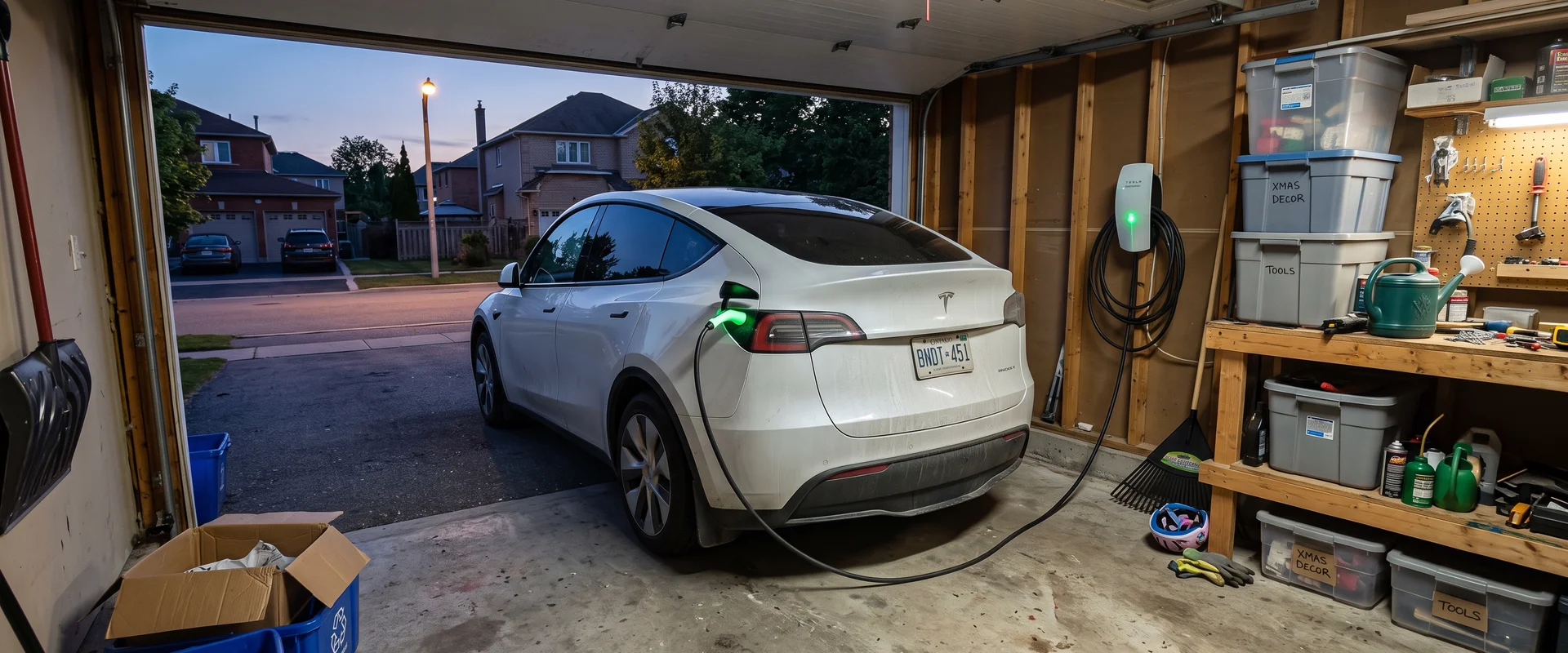
What is an EV load management system?
When your panel is near capacity, a smart EV Energy Management System lets you charge without a costly upgrade. We install DCC-9, DCC-12, and Black Box EVEMS devices, along with ChargePoint, Grizzl-E, and JuiceBox load sharing, using current transformer monitoring to shed the EV load only when the household peaks. Every install is compliant with OESC Rule 8-106.
The idea is simple. Your service has a maximum, but your house almost never draws it. Peak demand happens for an hour or two around dinner when the oven, the dryer, and the air conditioner overlap. An EVEMS watches the main conductors through CT clamps, and when the total approaches the limit it pauses the charger. Once demand falls, charging resumes.
That behaviour is why the code allows the EV load to be treated as non-coincident rather than counted at full value in the service calculation. It is not a workaround. It is a documented, inspected, code-recognized method that saves a lot of GTA homeowners several thousand dollars.
When does EVEMS beat a panel upgrade?
For a large share of the 100A homes across Scarborough, East York, Mississauga, and the older Toronto core, EVEMS is genuinely the right answer. A DCC-9 at $500 to $800 CAD installed alongside your charger does what a $2,500 to $4,500 CAD panel upgrade would have done, for the specific problem of adding one EV.
It is the wrong answer in three situations. If your service is already strained without the car, adding shedding logic to a service that is short on capacity year-round just moves the problem. If you are planning electric heat, a heat pump, a pool, or a hot tub, the electrical panel upgrade you defer today gets bought next year anyway. And if your panel has capacity but simply no free breaker spaces, a dedicated subpanel at $1,500 to $2,800 CAD is the cleaner fix.
We run the OESC Section 8 load calculation before quoting, so the recommendation comes from your numbers rather than from what is convenient to sell.
Common problems we solve
- “You need a $4,000 panel upgrade.” Often untrue for a single Level 2 charger on a 100A service.
- Nuisance shedding. A controller sized or configured wrong sheds constantly. We test under real household load.
- Full panel, plenty of capacity. That is a subpanel problem, and we say so rather than selling a controller.
- Two EVs on one service. Native load sharing plus an EVEMS above it handles both cars cleanly.
- Inspector questions. The Rule 8-106 calculation goes on the permit so the ESA inspection is straightforward.
What does the install involve?
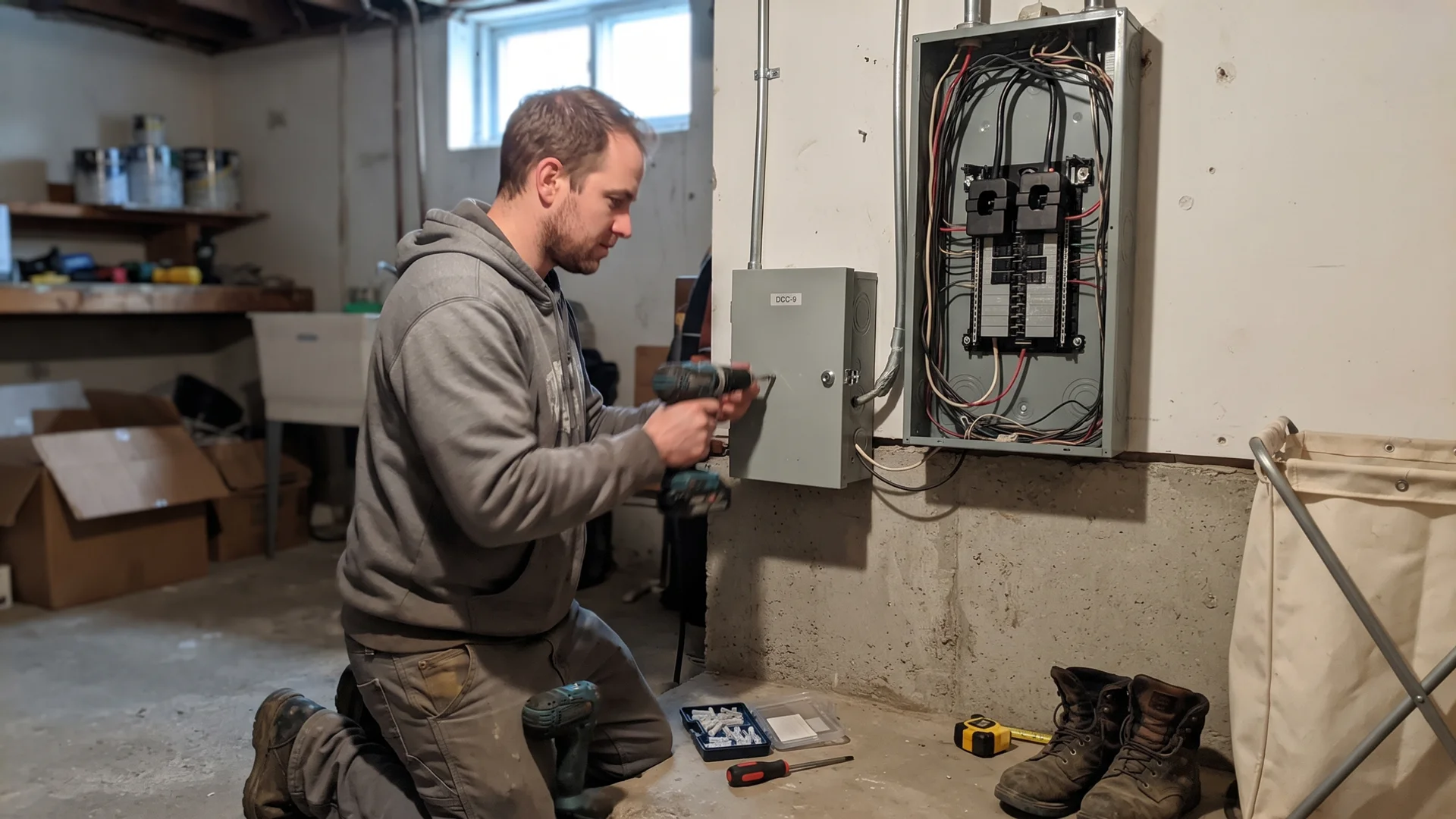
The controller mounts beside your panel. CT clamps go around the main service conductors so the device sees total household draw, and the EV charger circuit is routed through the controller so it can interrupt the charger without touching anything else in the house.
Then we test it properly. We load the house deliberately, watch the controller drop the charger at the threshold, and confirm it restores charging when demand falls. A datasheet says it should work. A clamp meter says it does.
Where your charger supports native load sharing, we may not need a separate controller at all. ChargePoint Home Flex, Grizzl-E, JuiceBox, and Tesla Wall Connectors can divide current between units directly, which is often the cheapest path for a two-charger household.
The ESA permit is filed, the inspection is booked, and the Certificate of Acceptance comes to you. That documentation matters twice: once for your insurer, and again for your Home Renovation Savings rebate claim, which we file on your behalf.
What does it cost across the GTA?
An EVEMS device installed alongside your Level 2 charger runs $500 to $1,200 CAD. A standalone retrofit on an existing charger runs $700 to $1,500 CAD because the circuit has to be reworked. Native charger load sharing, where your equipment supports it, is $300 to $700 CAD to configure and commission.
Against a $2,500 to $4,500 CAD panel upgrade, the arithmetic usually speaks for itself. But the honest version is that it depends entirely on your load calculation, and we would rather quote you the upgrade you actually need than the device you would rather hear about.